
AI Tools for Car Dealerships: 2026 Guide for Europe
Voice agents, lead follow-up, CRM, imaging, service: which AI tools a car dealership should choose in 2026, in what order, and which EU rules to check first.
A dealership can have an excellent sales team and still lose a customer because the phone rings at 7:30 pm. The dealership AI market now counts dozens of vendors, but the useful question stays simple: where does your dealership lose the most customers today? This guide sorts the tools by the problem they solve, then adds what US roundups leave out: the rules that apply in Europe, with France as our reference market.
 Illustration image
In short
- No single AI tool is best for every dealership: the right choice depends on your largest measured loss.
- The first project is often customer response (calls, chat, WhatsApp), because it does not depend on a large data project.
- In the US, 82% of dealers use AI, but only 22% of those users report sales growth from it so far (Cox Automotive, August 2026).
- In the EU, customers must be told when they are talking to an AI. In France, consumers must also consent before telephone marketing.
Sources and disclosure. This guide builds on the overview of dealership AI tools published by our partner Drivee AI in September 2026, along with our own checks. Drivee AI and GENIAL both sell solutions mentioned here. Tool capabilities are those published by each vendor: GENIAL has not tested them, and several vendors focus mainly on North America. Check availability in your country.
What is the best AI tool for a car dealership?
The best AI tool for a car dealership is the one that fixes its largest measured loss. Name the problem first, then choose the tool category.
| Your problem | Category to look at first | Metric to track |
|---|---|---|
| Missed calls | Voice agent or AI receptionist | Answer rate, lost calls |
| Leads going cold | Messaging agent and automated follow-up | First response time, appointments set |
| Service desk hard to reach | Service-focused AI | Service appointments, repair orders |
| Listings with few views | Imaging, 360° and merchandising | Clicks and vehicle page views |
| Customer base underused | CRM and customer data platform | Contact rate, sales from the base |
| Slow-moving inventory | Inventory and pricing tools | Days in stock, markdowns |
How are car dealers using AI in 2026?
Adoption is high, but commercial results remain the exception. The Cox Automotive AI in Auto Retail Tracker published in August 2026 covers 483 US dealers in the second quarter of 2026:
- 82% of dealers use AI.
- 69% expect it to drive sales and revenue growth.
- 22% of AI users report seeing that growth so far.
- About 1 in 3 either do not measure the impact of AI or are unclear on how they measure it.
- The most cited uses are task automation (40%), customer follow-up coordination (40%) and content creation (38%).
On the buyer side, 63% of people planning to buy a vehicle within 12 months expect to use AI for that purchase, according to the same study.
Cox also finds that dealers working with an outside AI partner are more likely to report sales growth (36% versus 21%). This is a correlation, and it suits service providers, GENIAL included. It still matches what we see in the field: AI agent projects rarely fail because of the technology, and more often because of poor scoping.
These figures describe the US market. Public data is scarcer in France: according to press sources (Challenges and Sud Radio, April 2025), 13 to 35% of calls to dealerships reportedly go unanswered. Measure your own rate before choosing a tool.
Which AI tools exist for dealerships, by category?
AI tools for dealerships fall into eight main categories. The table lists the vendors identified by Drivee AI in September 2026, in alphabetical order. It is not a ranking.
| Category | What the tool does | Example vendors |
|---|---|---|
| Voice agent | Answers calls, qualifies, routes | Drivee AI, Numa, Podium (Jerry), STELLA Automotive AI, Toma |
| Messaging agent | Answers by chat, SMS, email or messaging apps | Conversica, Drivee AI, Gubagoo, Impel, Matador AI |
| Follow-up and scoring | Follows up on leads, ranks priorities | Conversica, DealerSocket, Drivee AI, Impel, Matador AI, VinSolutions |
| CRM and customer data | Centralizes customer history | CDK CRM, DealerSocket, DriveCentric, Fullpath, Salesforce Automotive Cloud, VinSolutions |
| Marketing and listings | Targets campaigns, publishes inventory | DAS Technology, Drivee AI, Fullpath, Lotlinx |
| Imaging and 360° | Improves visuals, creates vehicle tours | CarCutter, Drivee AI, Impel, Spyne |
| Inventory and pricing | Helps decide on stock and prices | Drivee AI, Lotlinx |
| Service | Handles service calls, recalls and outreach | Drivee AI, Impel, Numa, STELLA Automotive AI, Toma |
The market moves quickly. Cox Automotive bought Fullpath in 2026, and Numa acquired Ficus to extend its offer from service to sales.
We do not repeat vendor-reported performance figures here, because they have not been independently verified. Ask for them during the demo, along with how they were calculated.
Why the service department deserves attention
Service is often left out of AI projects, even though a missed service call can cost a loyal customer. The 2026 Cox Automotive Fixed Ops and Ownership Study also shows the effect of visual proof: 49% of customers who received photos or videos say they are more likely to approve recommended work. Xtime, a Cox Automotive company, puts the gap at about $230 per repair order in the US market.
Where GENIAL fits
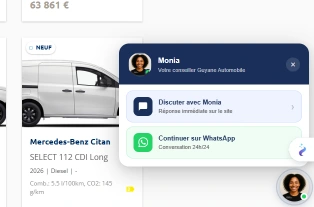
GENIAL's AI phone assistant answers 24/7, qualifies the request and transfers the call with its context. In France, we offer it to dealerships as GENIAL Auto. Without a connected DMS, the agent collects the request and sends it to the service team by email. It does not cover imaging, inventory or CRM. The dealerships of Guyane Automobile, part of the GBH group, use our AI agents on their websites and WhatsApp: see the GBH customer story.
How do dealership AI tools work together?
A chain of AI tools works when every request reaches the right place with its context. The typical journey has five steps:
- The customer calls or writes, often outside opening hours.
- The agent answers, understands the reason for contact and qualifies the request.
- The CRM records the exchange, so that no request stays in an isolated tool.
- Follow-up takes over if the customer is not ready to decide.
- An advisor takes over with the full history, for the test drive, the sale or the service appointment.
The weak point is nearly always between two tools. A brilliant agent that writes nothing to your CRM creates a second queue that nobody works.
 Illustration image
AI receptionist
- Answers 24/7
- Qualifies the request
- Transfers with context
 Illustration image
NovaTech Automobiles
Request sent to the service team
- Reason: service
- Preferred: Thursday morning
- Callback: caller's number
- Slot to confirm
Illustrative data
Which AI tools suit your dealership's size?
An independent dealership needs two tools used well, not ten subscriptions. The larger the group, the more useful data consolidation becomes.
| Structure | Start with | Then add | Keep for later |
|---|---|---|---|
| Single site | Phone and messaging agent, better photos | Automated listing distribution | CRM replacement |
| Group of 2 to 10 sites | Shared phone reception, follow-up tied to the CRM | Scoring, customer data, imaging at scale | Heavy in-house development |
| Large group | Data foundation and CRM, voice and messaging agents | Inventory tools, service AI across sites | Isolated tools with no per-site reporting |
For general office tools such as writing assistants, see our selection of AI tools for SMBs.
Which rules should European dealerships check first?
Three topics need checking before any rollout: customer notice, telephone marketing and personal data. US roundups discuss US law, which does not govern a European dealership. What follows is not legal advice: have your situation reviewed by your counsel.
- Disclose the AI. Article 50 of the EU AI Act has applied since 2 August 2026: people must know they are interacting with an AI system, unless this is obvious.
- Control outbound calls. In France, since 11 August 2026, telephone marketing to a consumer requires prior consent, unless it relates directly to a current contract. An agent calling your prospect base falls under this rule. An agent answering inbound calls does not. Other EU countries have their own rules.
- Protect personal data. The GDPR requires a legal basis, clear information and a contract with each processor. Check hosting, retention periods, call recording and whether data may be reused to train models. Govern informal use too: see our guide to shadow AI.
What should you test during an AI agent demo?
A useful demo leaves the vendor's script. Six tests reveal most of what matters:
- Ask a precise question about a vehicle in your real inventory.
- Send a vague message, with no model or context, and see how the agent recovers.
- Play an unhappy customer, then watch when the agent hands over to a person.
- Ask for information the agent cannot know: it must say so rather than invent an answer.
- Make an appointment request, then check what actually reaches your schedule or CRM.
- Ask not to be contacted again, and check that the request applies on every channel.
Ask for a reference from a dealership of similar size, and call them.
How do you measure the return on an AI tool?
Return on investment is measured against a baseline recorded before rollout. Without one, you join the third of dealers who cannot say what AI gives them.
| Metric | What it tells you |
|---|---|
| Call answer rate | Is the phone loss shrinking? |
| First response time | Do you reply before your competitors? |
| Appointments set and kept | Do conversations create traffic? |
| Share of requests handled without a person | How much load does the agent absorb? |
| Cost per appointment | Does the tool cost less than current coverage? |
The first calculation fits on one line: missed calls × share recovered × conversion rate × average margin. For example, 100 missed sales calls per month × 25% recovered × 10% conversion × €1,000 margin gives €2,500 of monthly margin (illustrative data). Run it with your own numbers and compare the result to the full cost of the tool.
Which mistakes should dealerships avoid with AI?
Most failures come from the organization, not the tool. Four mistakes come up often:
- Buying before naming the problem. "We need AI" is not a goal. "We lose service calls after 6 pm" is.
- Isolating one department. A sales agent that cannot see service history makes customers feel they are dealing with two companies.
- Forgetting the human exit. Every agent must offer a quick, simple route to an advisor.
- Neglecting the team. If your staff do not trust the tool, they will work around it.
Where should your dealership start?
Start by measuring your unanswered calls and requests for two weeks. You will then know which tool category to look at first. To test an agent in real conditions, try our AI phone assistant. To assess your whole company, take the GENIAL AI self-assessment.
Sources
- Drivee AI, Best AI Tools for Car Dealerships in 2026, September 2026.
- Cox Automotive, AI in Auto Retail Tracker, August 2026.
- Cox Automotive, Fixed Ops and Ownership Study, April 2026.
- Actu-Juridique, Réforme du démarchage téléphonique (in French), 2026.
- Goodwin, EU AI Act Transparency Obligations, August 2026.
Erwan Simon is CEO and co-founder of GENIAL, a Bordeaux-based company that specializes in the operational rollout of generative AI in SMBs and mid-market companies. He is an accredited AI Expert with Bpifrance (France's public investment bank) and an ambassador of "Osez l'IA," the French government's program to help companies adopt AI.
Frequently asked questions
What is the best AI tool for a car dealership?
No AI tool is best for every car dealership. The right choice depends on the largest measured loss: a voice agent for missed calls, automated follow-up for leads going cold, an imaging tool for listings that get few views. Each tool should target a problem you have measured before rollout.
Which AI tool should a dealership buy first?
A dealership should usually fix customer response first, because a voice or messaging agent does not require a large data project. It can start without a DMS connection by passing requests to the team. Replacing the CRM or adding a customer data platform comes later, mainly for dealer groups.
Will AI replace dealership staff?
AI mostly covers the moments when nobody can answer: evenings, weekends, call peaks and repetitive first questions. Staff keep the relationship, the test drive, the negotiation and the sale. A useful AI agent hands the team a summarized request, then lets a person take over.
What is the difference between a chatbot and an AI agent at a dealership?
A chatbot answers questions. An AI agent completes a task: it understands the reason for contact, qualifies the request, sends the file to the right department or acts in a connected tool. The test is simple: ask to see what actually reaches your CRM or schedule after the conversation.
Must European dealerships tell customers they are talking to an AI?
Yes. Since 2 August 2026, Article 50 of the EU AI Act requires that people are told they are interacting with an AI system, unless this is obvious. A dealership should plan this notice for phone and written channels, along with a simple route to a human advisor.
Take action on your AI strategy
The GENIAL AI self-assessment measures your AI maturity and gives you prioritized use cases in under 5 minutes. Free, no commitment.
Related articles
Reasoning AI: When to Pay for a Model That Thinks
Gemini 4 Argon scores 96.5% on scientific reasoning. Does that mean you need a reasoning model everywhere? The tasks that justify one, and the ones that don't.
Generative AI for Image, Video and Voice: Which to Choose?
Recraft, FLUX, Grok Imagine, ElevenLabs, Voxtral: which generative AI for visuals, videos and voices? Measured 2026 costs and speeds, and pitfalls to avoid.
AI Agents: Choosing the Right Model for Business Processes
An AI agent that acts in your tools must follow your rules. What the 2026 τ²-Bench benchmark reveals, and a method to pick the right model for your agents.