
AI for Hotel Groups: From Experimentation to Scale
The 5 traps that block AI ROI in hotel groups, and how to clear them before peak season. Case studies, figures and a roadmap from 150 GENIAL projects.

What you'll learn
- The 5 traps that block AI ROI in a hotel group, and how to clear them
- The 3U rule, so you never again launch a pilot that never dies
- The GENIAL AI-Native Flywheel for scaling across 10, 50 or 200 properties
- The catalog of AI agents for hotels and their measured gains (Huttopia case: 33x ROI)
- A concrete roadmap, and the AI assessment 50% co-funded by Bpifrance
AI White Paper: Hotel Groups Edition. From experimentation to scale in the hospitality industry.
They trust us: Huttopia · Siblu · Atout France · Sunêlia · Bpifrance · Le Saint-James (Relais & Châteaux) · Grottes de Lascaux · Charentes Tourisme · CEGID · Caran d'Ache · MAPA.
Editorial: why this white paper, and why now. When you ask hotel group executives how they use AI, nine out of ten say "we've tested it." Four out of five add: "but we can't manage to scale it." This is not a technology problem, nor a lack of appetite. It is a problem of method. This white paper is the result of three years of GENIAL projects with hotel groups, hotel networks, tourism bodies and public funders.
— Erwan Simon, CEO & co-founder, GENIAL · Lionel Bertounèche, Travel Director, GENIAL · Bpifrance Consulting Experts (Bpifrance is France's public investment bank) · National Ambassadors for the OSEZ L'IA program · IFTM 2024 award winner
The moment of truth
The French hotel industry counts more than 17,000 rated hotels, 650,000 rooms and annual revenue above €20 billion. Hotel groups are driving the move upmarket, the internationalization of guests and the battle for direct bookings against the OTAs (online travel agencies). And yet most of them are still stuck in the experimentation stage.
Three figures sum up what hotel groups are going through today:
- 90% of SMB and mid-market executives have already tested generative AI at work.
- Less than 15% have reached a scaled stage with measurable ROI.
- 68% of employees use AI outside any defined framework.
Sources: Bpifrance, AI Barometer 2025; McKinsey, State of AI 2026; aggregated GENIAL data from 150 assessment projects and 10,000 employees surveyed between late 2023 and early 2026.
Why hospitality is feeling this moment more intensely than other industries
- A massive, repetitive volume of guest contacts that grows with every property you open: online reviews, booking emails, complaints, concierge requests.
- A battle for direct bookings against OTAs that capture 30 to 50% of bookings with commissions of 15 to 25%. Every point of direct conversion counts.
- An international clientele that requires multilingual service at all times.
- High turnover in operational roles (front desk, housekeeping, F&B) that makes ongoing training expensive and service consistency fragile.
- Pressure on RevPAR amid rising operating costs, which forces you to find hidden productivity.
Where do you really stand?
Our 150 field projects show that hotel groups fall into four maturity levels. None of them is a stigma: everyone started at level 1.
| Level | Description | Typical signs in a hotel group |
|---|---|---|
| 1: Curiosity | People talk about it, nothing is deployed | The CEO tries ChatGPT. The revenue manager reads articles. Nothing changes in operations. |
| 2: Uncontrolled experimentation | A few tools tested with no framework | Marketing generates posts with AI. The front desk translates reviews with Google Translate. The Lyon front desk doesn't use the same tools as the Paris one. |
| 3: Structuring | Strategy defined, first deployments | An AI Lead appointed at headquarters. A first agent deployed across the whole network. An AI policy shared with everyone. |
| 4: Scale | AI is built into processes, ROI is measured | An agent handles multilingual guest relations 24/7 across all properties. ROI is presented to the executive committee. |
What we see in the field. 80% of the hotel groups we meet are stuck at level 2. Their problem is not access to AI: it is the method to scale it across 10, 50 or 200 properties. The following pages describe the 5 traps that keep them at that level, and how to clear them.
Trap #1: The pilot that never dies
Symptom: a chatbot tested in a pilot hotel, presented to the executive committee, then forgotten. Six months later, the license is still running, no one knows how many guests have used it, and the vendor is still sending invoices. It is a zombie pilot.
It almost always starts the same way: an enthusiastic hotel manager launches an AI project, the pilot runs for 3 weeks, the results are "promising," but no one has defined what "success" means. The pilot can neither succeed nor fail. It just keeps going.
The antidote: the 3U rule of AI
An AI project only exists if it is:
- Useful: it solves an identified, quantified business problem. "Improving guest satisfaction" is not enough; "responding to 100% of reviews in under 24 hours in 5 languages" is a goal.
- Usable: it is integrated with the PMS, the CRM and the front desk's messaging. Not isolated in a separate interface.
- Used: more than 60% of the team concerned has adopted it within 30 days. Below that, you stop or recalibrate.
"Using AI day to day has let us automate some time-consuming tasks. The innovative approach to AI, combined with the GENIAL platform, is a real plus for delivering AI projects." — Quentin Mosnier, E-merchandiser, VVF
Monday morning: a quick audit of your current pilots
| Question | If the answer is no | Immediate action |
|---|---|---|
| Can you name a quantified goal for this pilot? | You can't judge whether it succeeded. | Set the goal now, or shut it down. |
| Do you know who uses it and how often? | It is probably dormant. | Measure usage over 7 days, decide within 15 days. |
| Is it integrated with your PMS, CRM or messaging? | Adoption won't take off. | Integrate it or remove it from scope. |
| Is the monthly cost lower than the value it generates? | You are quietly losing money. | Cancel the subscription immediately. |
The Huttopia case: from pilot to strategic asset. Huttopia went from a chatbot tested internally (HuttoChat) to a tool its international teams use every day. Over 91 days, the agent handled 43,878 messages and 6,783 conversations in five languages. Estimated value: €700,000 a year, 33x ROI. Without the 3U rule, this project would have been yet another pilot. Video testimonial: Michel Durrieu, CEO International, Huttopia.
Trap #2: Invisible Shadow AI
Symptom: no one has told you about it, and yet everyone uses it. Your front desk staff ask ChatGPT to translate review responses, your marketing director generates visuals in Midjourney, your front office manager has Claude write complaint emails. Nothing is governed, nothing is tracked.
Hotel groups combine three amplifying factors: decentralization (each hotel improvises with its own tools), the volume of sensitive data (names, card numbers, passports, guest preferences), and no dedicated IT department in 80% of groups with fewer than 30 hotels. Shadow AI is not a behavior to punish: it is a signal that tells you where the real AI needs are in your organization.
The three risks you are taking without knowing it
- Leaks of guests' personal data to public American AI tools. Exposure to the CNIL (France's data protection authority) in the event of an inspection.
- Non-compliance with the AI Act, being phased in since 2025. The traceability obligations are not negotiable.
- Loss of brand consistency: each hotel writes with its own prompt, and your group's voice varies from one property to the next.
The antidote: turn Shadow AI into a sovereign framework
The right answer is neither a ban (unenforceable) nor tolerance (risky): it is giving your teams a secure, French AI framework suited to how they actually work.
-
Publish a one-page AI policy, posted in every back office and handed to every new hire.
-
Map current usage without punishing anyone: a half-day workshop per hotel is enough to identify 80% of Shadow AI usage.
-
Deploy a sovereign internal AI tool that replaces ChatGPT for the tasks you identified. Shadow AI disappears when the governed alternative is better.
-
85% of employees use unapproved AI tools (Maddyness).
-
1 prompt in 10 potentially exposes sensitive data (Harmonic Security).
-
4% of global revenue: the ceiling for GDPR / AI Act fines.
Product focus: GENIALYTICA, AI analytics for hotel groups. GENIALYTICA continuously analyzes the data going in and out of the AI tools on the market (ChatGPT, Copilot, Claude, Gemini) and redirects employees to sovereign agents. For a multi-property group, it is the only way to take back control without holding your teams back.
Trap #3: The magic Copilot… or the tragic one
Symptom: your headquarters has deployed 100, 300, 500 Microsoft 365 Copilot or ChatGPT Teams licenses. A five-figure monthly bill. Six months later, frontline teams say they "never really understood what it's for," half the licenses sit unused, and your competitors communicate better than you do.
Studies agree: six months after deployment, only 20 to 25% of Copilot licenses are actively used. In hospitality, that figure is even lower, because frontline teams (front desk, housekeeping, F&B) have neither the training nor the time to turn a generic tool into a daily gain.
Buying licenses means buying a tool. What produces ROI is the transformation: defining specific use cases, training teams on those cases, measuring usage and adjusting.
Three rules before buying licenses in bulk
- Identify 3 to 5 priority use cases with estimated ROI before placing any order.
- Start with one pilot hotel of 10 to 20 people, not the entire network.
- Plan a training and rollout support budget at least equal to the license budget for the first 12 months, driven by the business teams first.
Trap #4: No AI Lead
Symptom: you are convinced AI is a strategic topic. Yet when someone asks who leads it in your group, you answer "a bit of everyone," which means no one.
In a hotel group, AI topics involve executive leadership, marketing, guest relations, HR, finance and operations. Without a dedicated role, each hotel goes its own way, or worse, no one moves forward.
What the AI Lead is not: not a developer (they don't need to code), not an outside consultant (they must be internal to own the topic over time), not necessarily full-time, and not the CEO.
"I loved working with the GENIAL team. I'm leaving with a suitcase full of new knowledge and a much better understanding of AI topics. That's exactly what you expect from this kind of support: to come out of it self-sufficient." — Mathilde Murat, Product Manager, AI Lead program
Simplified job description
| Dimension | Details |
|---|---|
| Typical profile | Digital director, group marketing manager, cross-functional project manager, or manager of a pilot hotel. |
| Required skills | Curiosity, ability to explain things simply, project structuring. No technical prerequisites. |
| Reports to | Executive leadership or the marketing/digital department, depending on the size of the group. |
| Time allocated | 30 to 50% of an FTE for a group of 5-15 hotels. 1 dedicated FTE beyond 15 properties. |
| Support budget | Training (2 days, QUALIOPI-certified, France's quality label for training providers), methodology coaching over 3-6 months, AI platform subscription. |
| Main responsibilities | Monitoring, mapping use cases, running pilots, measuring ROI, training teams, AI governance. |
| Success metrics | Number of use cases at scale, adoption rate, demonstrable cumulative ROI, reduction in Shadow AI. |
Monday morning: appoint your AI Lead within 48 hours. List the 3 people in your group who fit the profile. Offer each of them a 30-minute conversation this week. By the end of the week, someone owns the topic: not an official title, just a clear mission for the next 6 months.
Trap #5: The ROI no one measures
Symptom: you deploy, the teams say "it's good," but no numbers come back. Your CFO is getting impatient, your executive committee has doubts, and your AI budgets are becoming hard to defend.
Every AI use case should be evaluated on two axes: business impact and feasibility. High-impact, high-feasibility cases are Quick Wins, and that is where you start.
| Hotel use case | Estimated annual impact | Feasibility | Quick Win? |
|---|---|---|---|
| Automated multilingual review responses | €30K-100K / 20 hotels | High | Yes |
| 24/7 digital concierge agent | €50K-150K / hotel | Medium | No, but a priority |
| Pre-stay upsell / cross-sell | +8-15% ancillary revenue | Medium | Needs scoping |
| Multilingual marketing content generation | €20K-40K / group | High | Yes |
| Candidate pre-screening (HR) | €15K-30K / group | High | Yes |
| AI-augmented revenue management | €200K-800K / network | Low | Strategic project |
The Huttopia case: ROI in numbers. 43,878 messages over 91 days · 4,139 hours saved · €700,000 in annual value · 33x ROI.
The method: the GENIAL AI-Native Flywheel
The five traps have one thing in common: they close in when adoption is treated as a by-product of the technical rollout. The GENIAL method reverses that logic. Adoption is not the consequence of the project, it is its first deliverable.
| Step | What happens | Deliverable in a hotel group |
|---|---|---|
| RUN | Launch a 3U-validated use case on a controlled scope | Multilingual review response agent, piloted in 3 hotels |
| TRACK | Measure usage and impact in real time | Dashboard: adoption, volume handled, time saved, NPS |
| LEARN | Identify what works and what gets stuck | Monthly AI committee, adjustments to prompts and scope |
| SHARE | Spread what you learn across the whole network | Prompt library, cross-hotel sessions |
| BUILD | Build on successes to expand | Extension to the AI concierge, then to revenue management |
"AI has transformed the way we plan trips. In a few minutes, it offers tailored, optimized recommendations. AI will evolve, but our confidence in the GENIAL team's skills remains." — Martine Roquet, Cooperative Development and Communications Manager, Cercle des Voyages
GENIAL AI agents for hospitality
GENIAL maintains a catalog of more than 40 pre-scoped AI agents that can be deployed in a few weeks. Here are the ones that apply directly to your business.
| Function | Agent | Value for hotels |
|---|---|---|
| Guest relations | Multilingual Review Response Agent | −70% time spent on Booking/Google/Tripadvisor reviews |
| Guest relations | 24/7 Digital Concierge Agent | +20% satisfaction, −60% tier-1 front desk questions |
| Guest relations | 24/7 Booking Assistant (digital + voice) | +15-25% conversion on the direct booking site |
| Marketing | Social Media & Local SEO Content Agent | 10 posts generated per hour + SEO-optimized hotel pages |
| Marketing | AI Mascot / Ambassador Avatar | +25% social media engagement, brand differentiation |
| Marketing | Pre-Stay Upsell / Cross-Sell Agent | +8-15% ancillary revenue per booking |
| HR | Candidate Pre-Screening Agent | −50% time spent sorting résumés during hiring season |
| Operations | Team Knowledge Base Agent | Instant answers to process questions for all staff |
| Operations | OCR Document Verification | −80% cost of verifying passports and documents |
| Leadership | AI NPS & Conversation Analytics Agent | Monthly dashboard of guest topics and friction points |
| Cross-functional | Internal Brain | All of the group's documentation searchable in plain language |
| Cross-functional | Secure Internal Chat | −70% Shadow AI, +80% AI adoption without leaving anyone behind |
Take action: choose your side
On one side, 95% of AI pilots fail in business (MIT NANDA). On the other, 75% positive ROI within 18 months for structured companies (McKinsey). The difference is not the tool, it is the method.
Path 1: You want to structure (level 2 → 3). The GENIAL AI Assessment, 50% co-funded by Bpifrance. 12 days over 6-8 weeks: usage audit, use case mapping, appointment of the AI Lead, 12-month roadmap, first 3U pilot. From €7,500 excl. VAT.
Path 2: You want to scale (level 3 → 4). Deployment of a GENIAL role-specific agent (review responses, concierge, upsell). Scoping + deployment in 4-8 weeks, Flywheel management over 6 months. From €15,000 excl. VAT + €1,500/month.
Path 3: You want to learn more. A 30-minute call with a GENIAL consultant. Free, no commitment. You come away with 2 or 3 priority AI use cases costed for your group, an ROI estimate and a first opinion on your maturity level.
"The collaboration went smoothly, with a team that listened and was proactive. Despite a tight deadline, the project was delivered on time. I highly recommend GENIAL's services because: They Are GENIAL." — Audrey Pierras, Retail Manager, Communauté de communes Vallée des Baux Alpilles
Get the full white paper, free
Leave your details to start reading right away. We'll also email you the white paper.
Take action on your AI strategy
The GENIAL AI self-assessment measures your AI maturity and gives you prioritized use cases in under 5 minutes. Free, no commitment.
Related articles
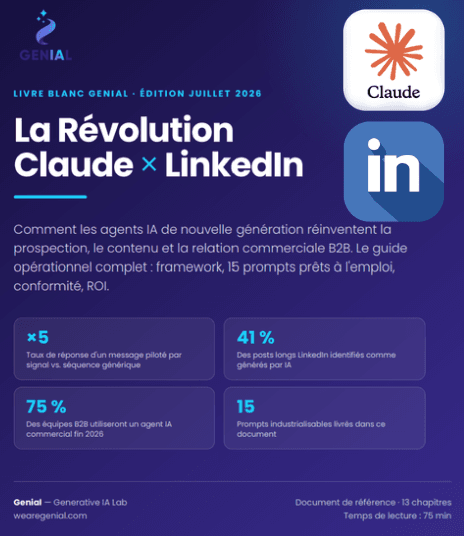
The Claude × LinkedIn Revolution
How next-gen AI agents are reinventing B2B prospecting, content and sales. The complete playbook: framework, 15 ready-to-use prompts, compliance, ROI.

AI: Your Vendors Will Sell the Work, Not the Tool
The shift from copilot to autopilot redefines what you'll buy in AI: not software, but a delivered result. What it changes for your SMB.
AI in Travel and Tourism: Real Use Cases and Gains
How AI is transforming tourism: multilingual customer service, content, booking, back office. Real use cases and gains, backed by field data.