
Why 95% of AI Agent Projects Fail
95% of AI agent projects deliver no ROI. The cause isn't the model, it's the engineering layer. The 5 reasons they fail and the questions to ask.
If your organization launched a generative AI project that didn't deliver, you're not the exception. An MIT study published in 2025 estimates that 95% of enterprise generative AI pilots produce no measurable return on investment, despite tens of billions of dollars committed worldwide.
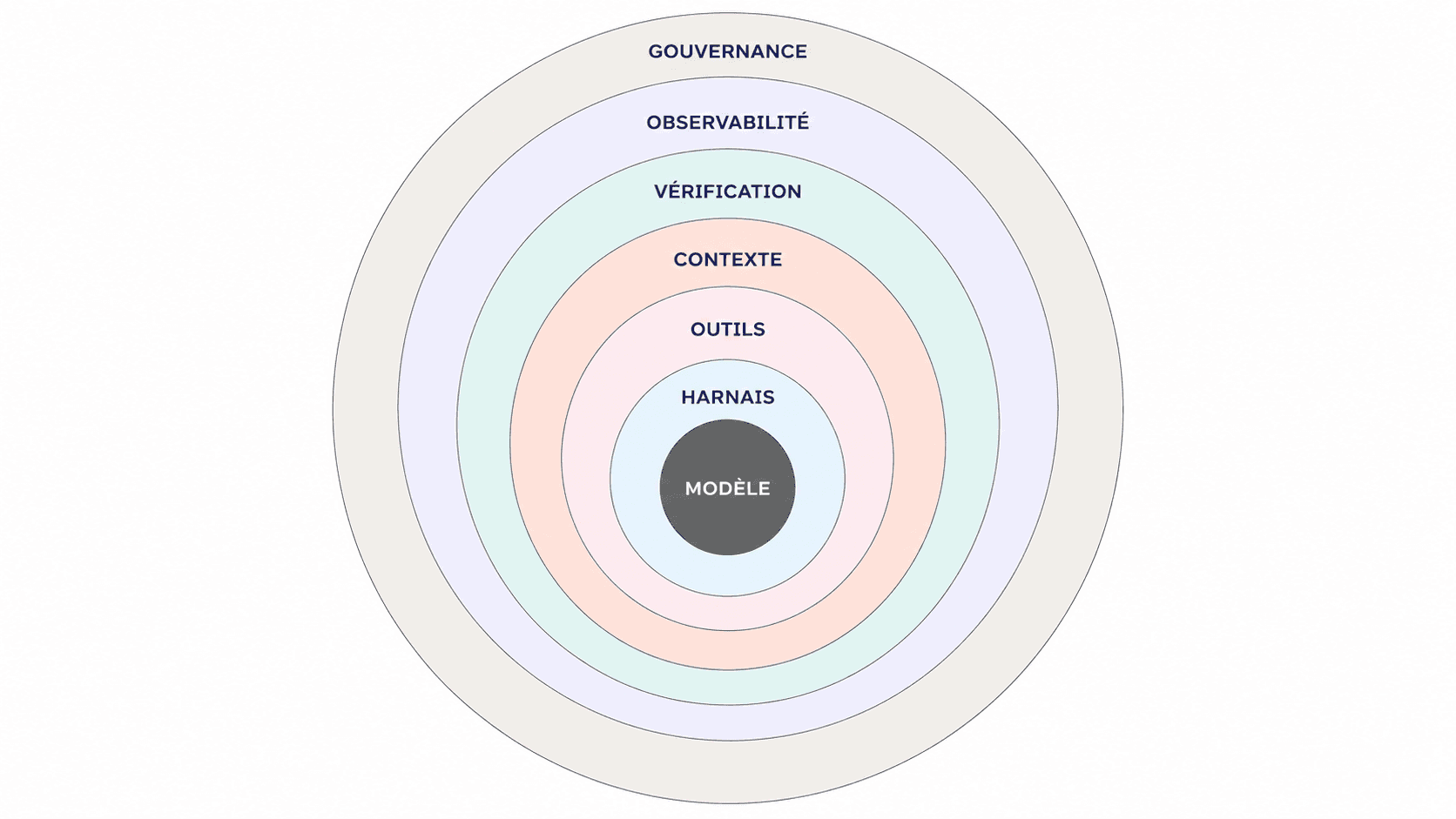
The first reflex is to blame the model: it wasn't good enough, we'll have to wait for the next generation. The 2025 and 2026 data say otherwise. The deciding factor isn't the model, it's the engineering layer around it: the execution loop, working-memory management, tool design, verification mechanisms, measurement. Technical teams now call it the harness.
An experiment published in 2026 makes the point: a team raised an agent's success rate on a benchmark task from 52.8% to 66.5% without changing the model, only by reworking that engineering layer. A gain of almost 14 points, more than moving to the next model generation often delivers. In other words, waiting for the next model won't fix the problem. Here's why, and what to look at instead.
What is an AI agent, and why does it fail differently from a chatbot?
An AI agent pursues a goal and acts in your systems, whereas a conversational assistant just answers a question. It's a difference in kind, not in degree.
A conversational assistant answers a question. You ask, it answers, the exchange ends. That's what most organizations deployed first.
An agent pursues a goal. It looks up data, takes actions, observes the results, decides what to do next, and repeats until the task is done. An assistant that gets it wrong gives a bad answer the user can judge. An agent that gets it wrong chains ten actions in your systems before anyone notices.
The reference loop, as the teams building these systems describe it, has four steps:
gather context → act → verify → repeat
The third step, verification, is the one almost always missing from projects that fail.
The five reasons AI agent projects fail
The causes of failure are no mystery. They repeat from one project to the next, and none of them depends on the model chosen. They map, one by one, to the engineering rings around the model.
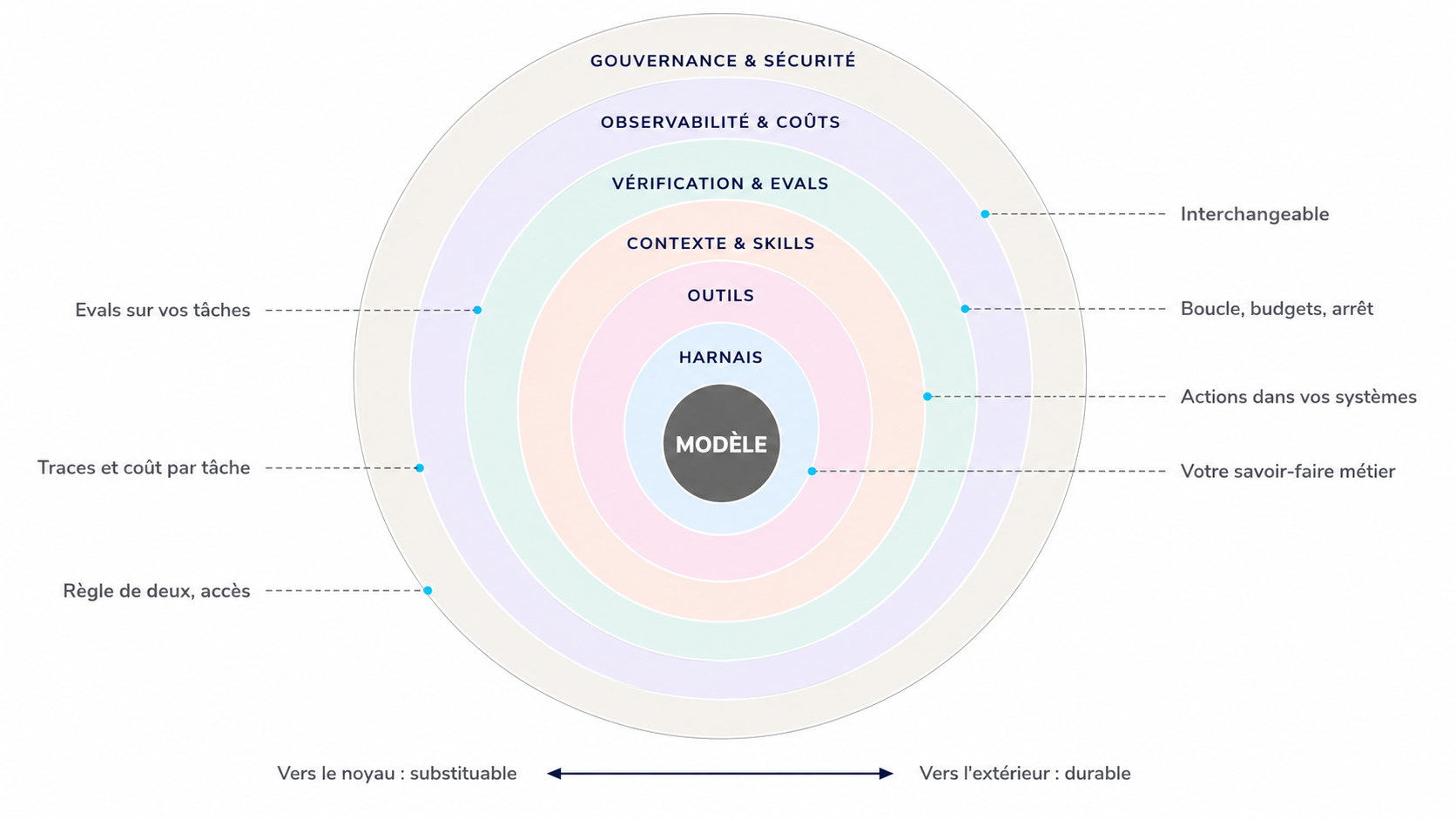
The model sits at the core, but it's the most replaceable layer. Value and independence are built in the rings around it, where your business know-how is encoded.
1. The agent can't check its own work
This is the most common cause of failure and the least visible. An agent with no way to check its output produces results that are plausible and wrong: well phrased, consistent, in the expected format, and incorrect. Nobody notices until the end customer, the regulator or an employee finds out.
A counterintuitive lesson from recent research: models are poor self-critics. Asking an agent "are you sure about your answer?" doesn't produce reliable verification. You need either an external, objective control mechanism or a second agent explicitly set up as a skeptic that doesn't share the first one's context. The phrase making the rounds in engineering teams: write the verifier before you scale the generator.
The question to ask a vendor: concretely, how does this agent check its own work?
2. Working memory degrades silently
You often hear that a model has a 200,000-token "context window," as if it were a hard drive. That's misleading. A 2025 study of eighteen models showed that performance becomes steadily less reliable as the context grows. A window advertised at 200,000 tokens can lose significant accuracy well before it reaches 50,000. The phenomenon has been named context rot.
The practical consequence matters: loading the company's entire document base into the window isn't a strategy; it's actually counterproductive. The design principle that emerges is the opposite: find the smallest set of high-signal information that gets the right result. Along the way, this rehabilitates targeted document retrieval (RAG), which some wrote off a little too quickly in 2025 on the grounds that windows were getting bigger.
The question to ask: what happens when the agent works on a long task, and how does it handle what it needs to forget?
3. The tools are poorly designed
An agent acts through "tools": functions that let it query a database, send a message, create a record. The quality of those tools largely determines the success rate. Two concrete examples.
On granularity. An agent given three tools (list employees, list time slots, create an event) has to orchestrate the sequence itself, and regularly gets it wrong. An agent given a single planifier_un_rendez_vous (schedule a meeting) tool succeeds much more often. Consolidation beats multiplication.
On error messages. A tool that returns "Error 500" is useless: the agent doesn't know what to fix, retries the same thing and loops. A tool that returns "the date_debut field must be in YYYY-MM-DD format, received 12/03/2026" lets the agent correct itself, immediately. A few lines of code that measurably change the success rate. This level of detail never shows up in a sales demo; it shows up in production, six weeks later.
The question to ask: were the tools exposed to the agent designed for it, or are they simple wrappers around existing APIs?
4. There is no measurement
Without measurement, continuous improvement remains an intention. There's no way to know whether a change improved or degraded the system: teams make changes by feel, and quality drifts without anyone being able to document it.
The reference practice is called evaluations (evals): a set of real tasks, representative of actual use, with verifiable results, replayed after every change. It's the equivalent of regression testing in classic software development. The scale is modest: a hundred tasks represent a few hours of engineering and a few dozen euros in API costs. It's not a project; it's the condition for everything else to be manageable.
A word of caution: public benchmark scores say little about performance in production. A 2026 audit found that 59.4% of the hardest tasks in a reference benchmark had inadequate tests, and a university team showed that the eight major agentic benchmarks can be "gamed" by systems optimized for the score. Gaps between evaluation methods reach 30 to 50 points. What counts are evaluations built on your real tasks, not public leaderboards. That's exactly the logic of an AI assessment run on your own processes rather than on generic cases.
The question to ask: on what set of tasks from our business is this system evaluated, and how often?
5. Costs are out of control
The 2026 paradox: model prices are collapsing (down about 67% in a year for the most capable models) and bills are going up. The explanation is simple. An agent consumes five to thirty times more resources per task than a simple question-and-answer exchange, because it loops, calls tools, rereads results. A full agentic session can run to several million tokens.
The operational risk is rarely anticipated: a misdirected agent doesn't crash, it politely loops, spending real money on every turn. A job stuck over a weekend turns a margin into a loss. The necessary safeguard is a hard budget: number of steps, processing volume, and above all a spending cap that stops the agent before the next paid call, not after. It's one line of code, and it's regularly missing. This runaway bill is the technical counterpart of the strategic problem described in The AI bill is the wrong question.
The question to ask: what is the maximum cost a task can reach before it's automatically stopped?
What sets apart the 5% of AI agent projects that succeed?
The ones that succeed don't target "AI" but a specific pain point, fit into the existing workflow, build in memory, and work as a partnership rather than a license purchase. The MIT study cited at the start names the deciding factor the learning gap: generic tools don't adapt to a company's real processes.
Four traits recur among those that create value:
- They target a specific pain point. Not "roll out AI," but "cut the processing time for warranty claims." A narrow scope, a single metric, an identified group of users.
- They fit into the existing workflow. The agent steps in where the work already happens, in the tools teams already use. An agent that requires switching screens is an agent that won't get used.
- They build in memory and learning loops. The system improves from its failures, and that improvement is captured somewhere, not in a consultant's head.
- They work as a partnership rather than a license purchase. Because most of the work isn't in the initial rollout, but in the months that follow.
That last point is counterintuitive for leadership used to classic software projects: in an AI agent project, going live isn't the end of the project, it's the start of the phase where the value is won or lost. Identifying that specific pain point and prioritizing the right use cases is precisely what an AI maturity self-assessment reveals.
Does an AI agent project really make your company independent?
Yes, but independence rests on the engineering layer, not just on where the data is hosted, and it has to be demonstrated rather than declared.
If the business intelligence (your procedures, your rules, the way you handle a case) lives in the engineering layer and not in the model, then your dependence on an American provider shrinks to a dependence on inference. And inference is replaceable: you switch providers by changing a configuration setting. That's a far stronger argument than the usual talk about hosting, because it can be demonstrated.
One nuance established by 2026 research deserves to be stated up front, before a vendor sells you an unverifiable promise. The harness isn't model-neutral: the same architecture that improves one model by ten points can degrade another by as much, because of concrete incompatibilities. A recent review measures variations ranging from a few points to more than sixty depending on models and domains. Portability across models is real in principle, but it requires tuning and re-evaluation at every change. Formats are open and transferable; performance isn't automatically.
Hence a direct question for any vendor who talks to you about sovereignty: "we're model-agnostic" is an unverifiable claim without evaluations measured model by model. Ask for the numbers. As for European solutions in 2026, open models have made significant progress on agentic capabilities, tool use in particular, and allow on-premises or hybrid deployment; a gap remains on the longest tasks. The honest position is a two-tier architecture: sovereign by default, a frontier model where the gap justifies it, and transparency about that choice. This topic, now a political one, is covered in AI sovereignty: when unplugging an AI becomes a 2027 presidential election issue.
How do you secure an AI agent without being an expert?
Two rules are enough to frame a security conversation without jargon, and you can sketch them on a whiteboard in thirty seconds.
The rule of three combined risks. An agent becomes dangerous when it combines three properties:
- access to confidential data,
- exposure to untrusted content (incoming emails, external documents, web pages),
- the ability to communicate externally.
An agent that combines all three can be hijacked to exfiltrate your data, not through a classic software flaw, but through an instruction hidden in a document it processes.
The rule of two. An agent running without human supervision should meet at most two of these three properties, never all three. It's not a constraint to work around; it's a design framework: for each agent, you either limit its access, control its sources, or keep a human in the loop.
The threat is real: detected malicious injections rose by about a third between late 2025 and early 2026, and compromised software components have been distributed publicly (in one case, fifteen clean versions before a line of exfiltration code was quietly added). The defensive practices to require are standard: least privilege, isolated execution environments, human approval for any irreversible action, and auditing third-party components before installing them. This exposure extends the issue of Shadow AI, when unsupervised use slips out of leadership's control.
The questions to ask your vendor
You can use this checklist as is, internally or with a vendor. It requires no technical expertise, only the determination to get precise answers rather than reassuring ones.
On reliability
- How does this agent check its own work?
- What happens when it fails, and how do we know?
- On what set of tasks from our business is it evaluated?
- How often is that evaluation replayed?
On control
- What is the maximum cost of a task before it's automatically stopped?
- Can we trace, step by step, what the agent did on a given task?
- How is cost broken down by task and by department?
On durability
- Where does our business know-how live: in a readable configuration file, or in proprietary code?
- If we switch models, what has to be redone, and at what cost?
- When the system is improved, how do we benefit without breaking our customizations?
On security
- Does this agent combine the three risks?
- Which actions require human approval?
- Have the third-party components been audited?
A vendor who answers these questions precisely has done the work. A vendor who answers by talking about the model they use hasn't.
Key takeaways
The model isn't the point. It has become a largely interchangeable component. Value and reliability lie in the engineering layer around it, and in the business knowledge encoded there.
Waiting for the next generation won't fix anything. Projects that fail today will fail with the next model, for the same reasons: no verification, no measurement, no cost control.
Going live isn't the end of the project. It's when the work that creates value begins. An AI agent project scoped like a classic software project (scoping, development, acceptance testing, close-out) fails by design.
Independence is built, not declared. It depends on your know-how being encoded in readable, versioned and transferable artifacts, not on a promise of model agnosticism or on where the data is hosted.
The right questions aren't technical. They're about verification, measurement, traceability and ownership of know-how. An executive team can ask them without prior expertise, and the quality of the answers is itself an indicator. To know where to start, GENIAL's AI maturity self-assessment places your organization in a few minutes.
Main sources
- MIT Project NANDA, The GenAI Divide: State of AI in Business, 2025 (52 organizations, 153 executives, more than 300 deployments). The 95% figure is widely cited and its methodology is debated: it's a strong signal about the difficulty of integration rather than a definitive measurement.
- Anthropic Engineering, 2025-2026 publications on agent design, context engineering, tool design and harnesses for long-running agents.
- Chroma Research, Context Rot: How Increasing Input Tokens Impacts LLM Performance, 2025 (evaluation of 18 models).
- LangChain, 2026 work on harness engineering and performance variation with the model held constant.
- 2026 academic reviews on agentic system design and cross-model portability, and 2025-2026 publications on agent security (rule of three combined risks, rule of two).
This field moves fast. The figures cited reflect the publications available at the time of writing (July 2026).
Erwan Simon is CEO and co-founder of GENIAL, a Bordeaux-based company that specializes in the operational rollout of generative AI in SMBs and mid-market companies. He is an accredited AI Expert with Bpifrance (France's public investment bank) and an ambassador of "Osez l'IA," the French government's program to help businesses adopt AI.
Take action on your AI strategy
The GENIAL AI self-assessment measures your AI maturity and gives you prioritized use cases in under 5 minutes. Free, no commitment.
Related articles

Why CFOs Can't Wait for Certainty in the AI Economy
Why waiting for a certain ROI has become a risk: the 3 mindset shifts CFOs need in the age of AI. An op-ed by Erwan Simon.

The AI Bill Is the Wrong Question
While France worries about the price per token, OpenAI and Anthropic are investing $5.5B in the human cost of AI. An op-ed by Erwan Simon, CEO of GENIAL.
How to Run an AI Assessment for Your Business
A step-by-step method for running an AI assessment in your company: scoping, employee survey, interviews, use case scoring and roadmap. A concise guide.