
Own Your Intelligence: Sovereign AI in Practice
Renting an AI model is not owning it. What an SMB or mid-market company must control for its AI to become an asset: model, harness, context and memory.
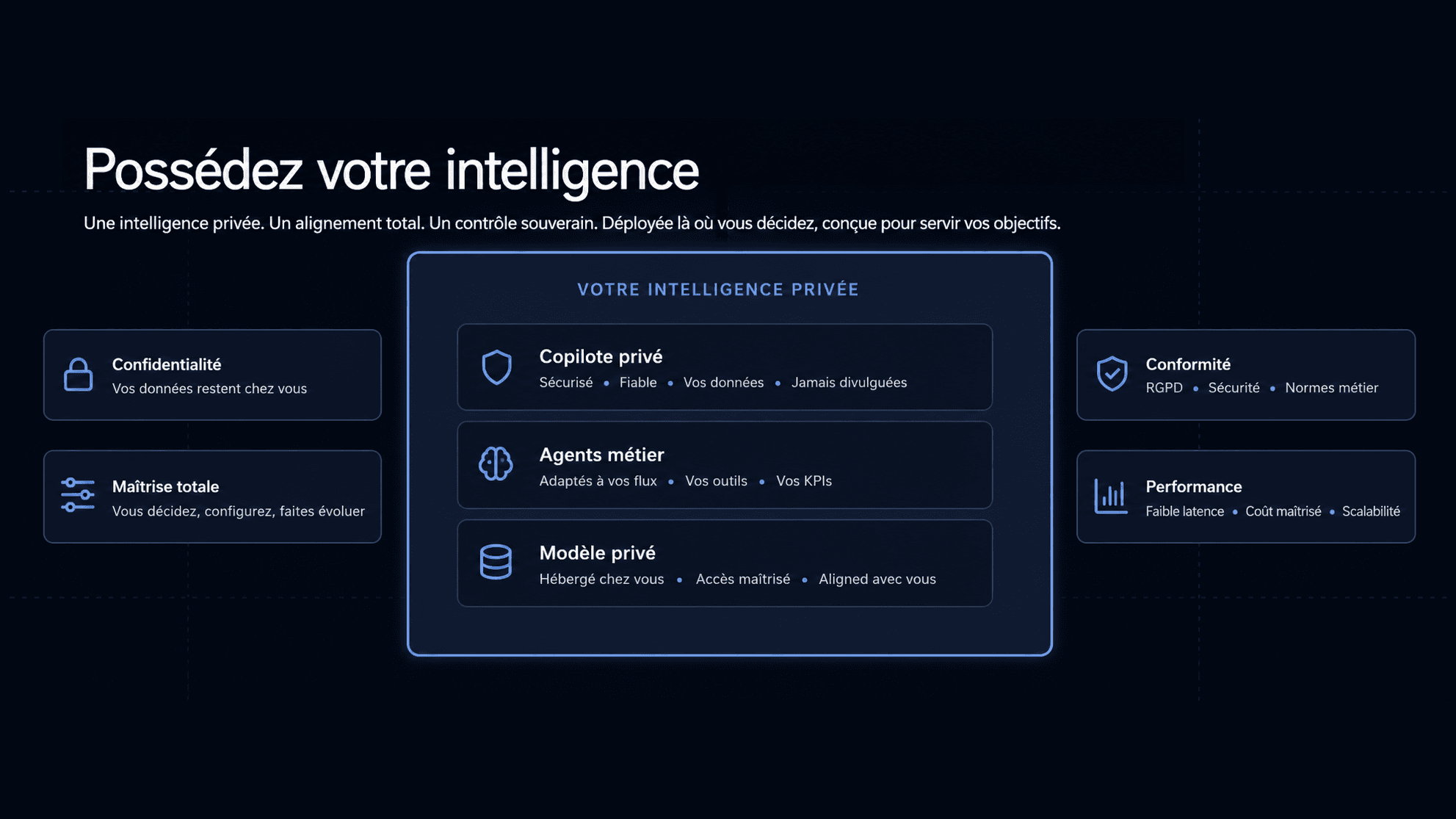
In June 2026, a single US administrative decision was enough to make two of the most widely used AI models in Europe disappear overnight. French companies that had put these models at the heart of their processes discovered, in one weekend, that they owned nothing of what they had built on.
This is the question most business leaders have not asked yet: does your company use AI, or does it rent it?
At a glance
- Generic AI is a starting point, never a competitive advantage: anyone can call the same API.
- Owning your intelligence means controlling four things: the model, the orchestration harness, business context and memory.
- Owning also means controlling your AI's cost, quality, limits of action and traceability.
- In France, this ownership has a second name: sovereignty. It comes down to three concrete points: extraterritoriality, reversibility, traceability.
- Buy the generic infrastructure. Own the layer where the advantage compounds.
What does it mean to "own your intelligence"?
Owning your intelligence means controlling the elements that determine how an AI behaves, what it costs, what it learns from and whether it improves over time. It does not mean building every layer from scratch.
The clearest analogy is the supply chain. A retailer builds neither its trucks, its ships nor its warehouse robots. But it owns the system that decides what gets bought, how inventory moves and how demand is forecast. No one calls it dependent because it buys its trucks. It would become dependent if it let its carrier choose its suppliers.
AI works the same way. You can buy the models, the computing power and the hosting. You must own the system that turns those inputs into intelligence specific to your company.
Why isn't generic AI enough to create an advantage?
Because, by design, it is available to your competitors on the same terms. A foundation model is a component anyone can call with the same credit card and three lines of code. What cannot be replicated is what you put around it.
Companies have a great many specifics in how they operate. The more deeply AI is built into operations, the more those specifics become decisive.
Take a French insurer that equips its claims handling with AI. A generic model reads a policy, summarizes a claim and explains common coverage concepts. But actually paying out depends on the insurer's own contract language, the obligations of the French Insurance Code, the regulator's expectations, inter-company agreements, fraud signals, historical claims patterns, escalation rules and management's risk appetite.
None of that is in a generic model's weights. The model knows what a deductible is. It does not know how to handle this claim, for this customer, under this regime, within this policy, with these supporting documents, or what your risk department decided the day all three contradicted one another.
The same logic applies when AI is the product you sell. A software company building a legal assistant or a support agent does not sell the base model: it sells the workflows, the retrieved context, the tools called, the evaluations that define quality and the accumulated memory. The model is the raw material, not the product.
What should you buy, and what should you own?
The rule is simple: buy what is hard, generic and non-differentiating; own what encodes your business. Here is where the line falls.
| Buy | Own |
|---|---|
| Computing power and GPUs | The orchestration harness |
| Foundation models | Business context and memory |
| Storage, networking, hosting | Evaluations and the definition of quality |
| Standard observability components | Guardrails, permissions and limits of action |
| Connectors to your systems | The traces → feedback → improvement loop |
The left column is a market: others will do it better and cheaper than you, and prices there fall every year. The right column is an asset: it gains value with use, and giving it away amounts to renting your own differentiation.
What are the three layers you need to control?
An AI agent is the bridge between raw intelligence and real work. Three layers determine whether it belongs to you: the model, the harness and the context. You need control over all three, not two.
1. The model: preserve optionality
Controlling the model means, first of all, being able to change it. Open-weight models (Mistral, Llama, Qwen) bring portability: the ability to host them where you choose and to freeze a version in time. But the underlying requirement is not to use any particular model, it is to preserve optionality, that is, the ability to switch from one provider to another as your quality, cost, latency or confidentiality requirements change.
Optionality is defensive, because it prevents lock-in. It is also offensive: it lets you adopt the best model as soon as it is released, without a six-month project.
2. The harness: the orchestration logic
The harness is the engineering layer that turns a model's outputs into actions: routing, tool calls, workflow steps, checks, working memory. That is where most of the behavior specific to your company lives, and it is also why 95% of AI agent projects fail with the model having little to do with it.
If the harness is closed, you accept a third party's assumptions about how your business should work. You can neither know exactly what goes into the model at each step nor fix a behavior without depending on someone else's timeline.
3. Context and memory
Context is what makes generic intelligence specific: documents, internal procedures, tools, user preferences, organizational knowledge. Memory is its most strategic part, because it is what makes the system more useful every month.
The rule fits in one sentence: if you don't own the context and the memory, you don't own the intelligence your system accumulates. That is also why Shadow AI costs you twice: the data goes to a third party, and the learning that comes from it stays with them.
Why is sovereignty a specifically French issue?
Because a French company answers for its AI to European authorities while relying overwhelmingly on providers subject to US law. That gap comes down to three specific points, and none of them can be handled by a contract clause alone.
1. Extraterritoriality. The US Cloud Act, passed in 2018, lets US authorities demand data held by a company subject to US law, whatever country the servers are in. So the right question is not just "where is my data?" but "who can legally be compelled to access it?" Answering that requires knowing which data leaves your perimeter, at which step and for which model call. That is a property of the harness, not of the hosting provider. Hosting in France, even with SecNumCloud qualification from ANSSI (France's national cybersecurity agency), is a useful condition, never a complete answer.
2. Reversibility. Your buyers already require it by contract. It is only worth something if it is technically true: being able to rerun the same agent on another model, another cloud or on-premises, without rewriting the system. The June 2026 shutdown, which made AI sovereignty an issue in France's 2027 presidential election, showed the cost of reversibility that existed only on paper. A provider deprecating a model should never be a production incident.
3. Traceability. GDPR yesterday, the EU AI Act (in force since August 2024) today: as documentation and human oversight obligations ramp up, you need to be able to show what an agent saw, what it did and why. That proof cannot be produced after the fact. It is designed into the system, or it does not exist.
How do you manage the cost, quality and risk of AI in production?
As soon as an AI does real work, you manage it like any other operational system. Four instruments are enough, and each can be checked with a question any business leader can ask.
- Cost. Intelligence is only valuable if it is cheap relative to the gain it produces. Inference bills track adoption, and adoption moves fast. Being able to cap spending per user, per team or per agent is what lets you scale without discovering the bill the following quarter. That is also why the AI bill is often the wrong question: it is not the price per token that gets out of hand, it is unmeasured usage. Test: do you know what your most-used agent cost you yesterday?
- Quality. It is measured, not assumed. Switching models, changing an instruction, adding a tool: you need to know whether the system got better or worse. Without that measurement, no methodical improvement is possible, and so no real control. Test: can you prove an update didn't break anything?
- Limits. They define where AI acts on its own and where a human decides: what data the agent can reach, what tools it can call, which actions require approval, when it must escalate. Owning your intelligence means controlling what it is allowed to do. Test: who authorized an agent's last irreversible action?
- Observability. It makes the system accountable. If an agent acts, the company must see what it saw, what it did, which tools it called and why. That is what lets you improve, audit and then trust, in that order. Test: can you hand an auditor the complete trace?
How does an AI become more useful over time?
Through a learning loop the company must own. The hundredth interaction should be worth more than the first, because the system has learned more about your users, your procedures, your failures and your preferences.
The loop has four stages:
- Traces record what the agent actually did: what context it saw, which tools it called, where it got stuck, what it produced.
- Feedback gives them meaning: was the behavior useful, accepted, rejected, inefficient, risky or wrong?
- Modifications turn that finding into change: instructions, harness, tools, data made available.
- Evaluations lock in the gain, so that a later change does not destroy it without anyone noticing.
Without the fourth stage, the loop turns but accumulates nothing: every improvement remains at the mercy of the next change. And if the traces and learnings are not portable to another system, it is not your company that is learning, it is your provider's.
The ownership test: 10 questions for your executive committee
These ten questions can be answered yes or no. Each "no" points to a dependence that will only show the day it causes a problem.
- If a new provider released a clearly better model tomorrow, could you switch to it without a major project?
- If your provider deprecates the model you use, could you host it yourself to avoid an outage?
- Do you know exactly what goes into the model at each step of your processing?
- Can you run the same agent on another cloud, or on-premises?
- Can you track and cap AI spending per user?
- Can you show the complete trace of the steps an agent took, and the reasoning behind them?
- Do you have evaluations that let you switch models without fearing a regression?
- By the hundredth use, does your agent know more about its user than it did the first time?
- Can you take those learnings with you to an entirely different system?
- Do you control how your agent learns?
Fewer than five "yes" answers: you consume intelligence, but it is not compounding yet. Five to eight: you control usage, not yet the system. Nine or ten: your intelligence belongs to you.
Key takeaways
Generic AI does not create an advantage. It is available to your competitors on the same terms, at the same price, on the same day. The advantage comes from what you put around the model.
Owning does not mean building everything. It means controlling the harness, the context, the memory and the improvement loop, while buying infrastructure and models without a second thought.
Sovereignty is a property of the system, not a line in the contract. Extraterritoriality, reversibility and traceability are designed into the architecture. A reversibility clause no team has ever tested is not a guarantee, it is an intention.
What counts is not the first use, it is the hundredth. If your system does not improve with use, you are paying an expense. If it improves and the learnings belong to you, you are building an asset.
To see where your organization stands before committing to anything, GENIAL's AI maturity self-assessment evaluates your actual usage, your dependencies and your ability to manage AI in a few minutes. It is the simplest starting point for knowing what you already own, and what you are renting without realizing it.
Sources and references
- Cloud Act (Clarifying Lawful Overseas Use of Data Act), United States, 2018.
- EU Artificial Intelligence Act (AI Act), in force since August 2024, with obligations phased in by risk level.
- SecNumCloud qualification, ANSSI, the French framework of requirements for trusted cloud service providers.
- Suspension of access to the Mythos 5 and Fable 5 models in June 2026, analyzed in our article on AI sovereignty and France's 2027 presidential election.
- MIT Project NANDA, The GenAI Divide: State of AI in Business, 2025, on the gap between pilots and value delivered.
This field moves fast. The points cited reflect the publications available at the time of writing (July 2026).
Erwan Simon is CEO and co-founder of GENIAL, a Bordeaux-based company that specializes in the operational rollout of generative AI in SMBs and mid-market companies. He is an accredited Bpifrance AI Expert (Bpifrance is France's public investment bank) and an Ambassador for its "Osez l'IA" ("Dare to use AI") program.
Take action on your AI strategy
The GENIAL AI self-assessment measures your AI maturity and gives you prioritized use cases in under 5 minutes. Free, no commitment.
Related articles

AI Sovereignty: How Fable 5 Hit France's 2027 Election
In one weekend, the Fable 5 / Mythos 5 crisis made AI a national sovereignty issue in France. What happened, the politics, and 3 lessons for leaders.
The Claude × LinkedIn Revolution
How next-gen AI agents are reinventing B2B prospecting, content and sales. The complete playbook: framework, 15 ready-to-use prompts, compliance, ROI.
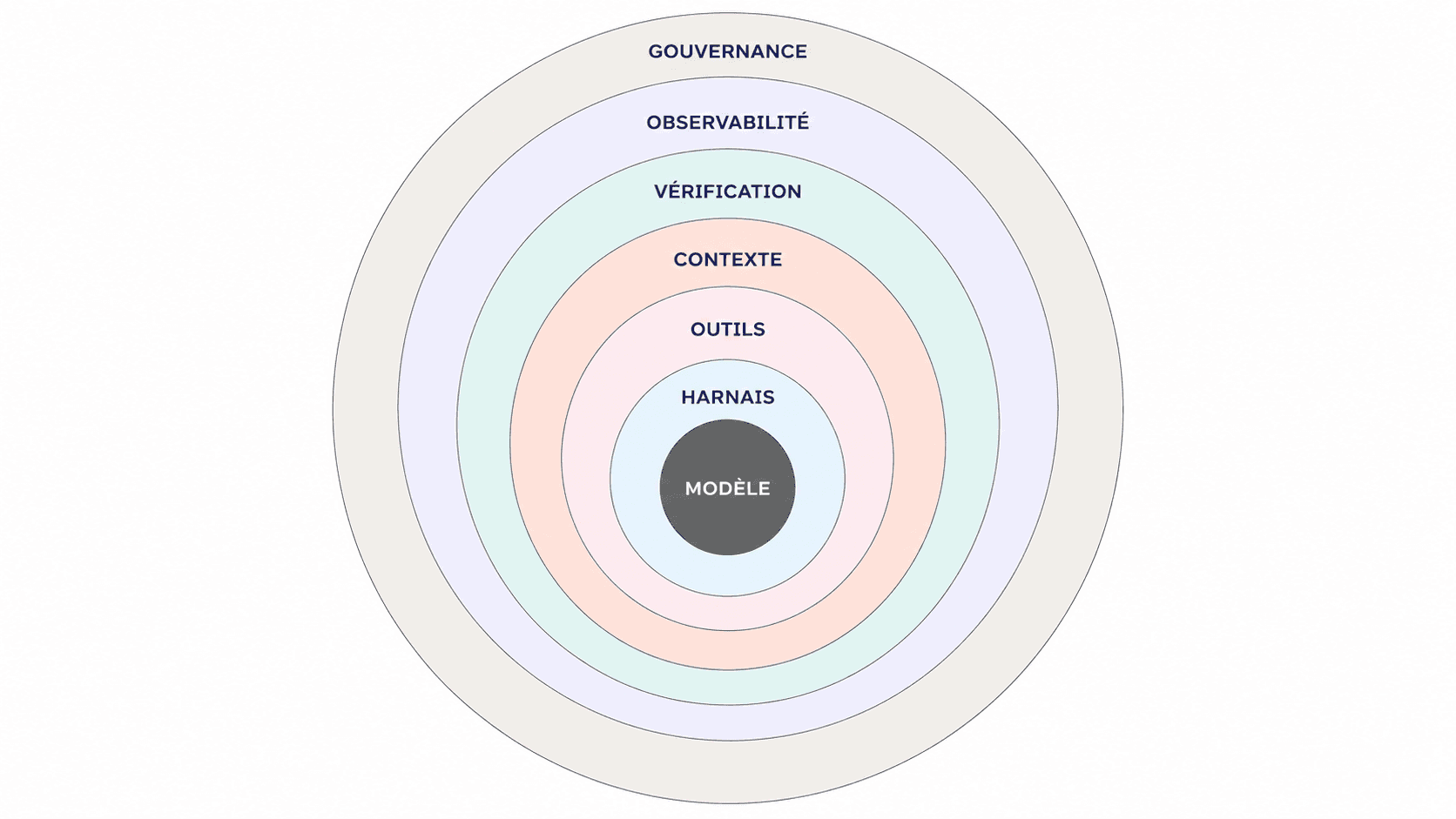
Why 95% of AI Agent Projects Fail
95% of AI agent projects deliver no ROI. The cause isn't the model, it's the engineering layer. The 5 reasons they fail and the questions to ask.