
AI Sovereignty: How Fable 5 Hit France's 2027 Election
In one weekend, the Fable 5 / Mythos 5 crisis made AI a national sovereignty issue in France. What happened, the politics, and 3 lessons for leaders.
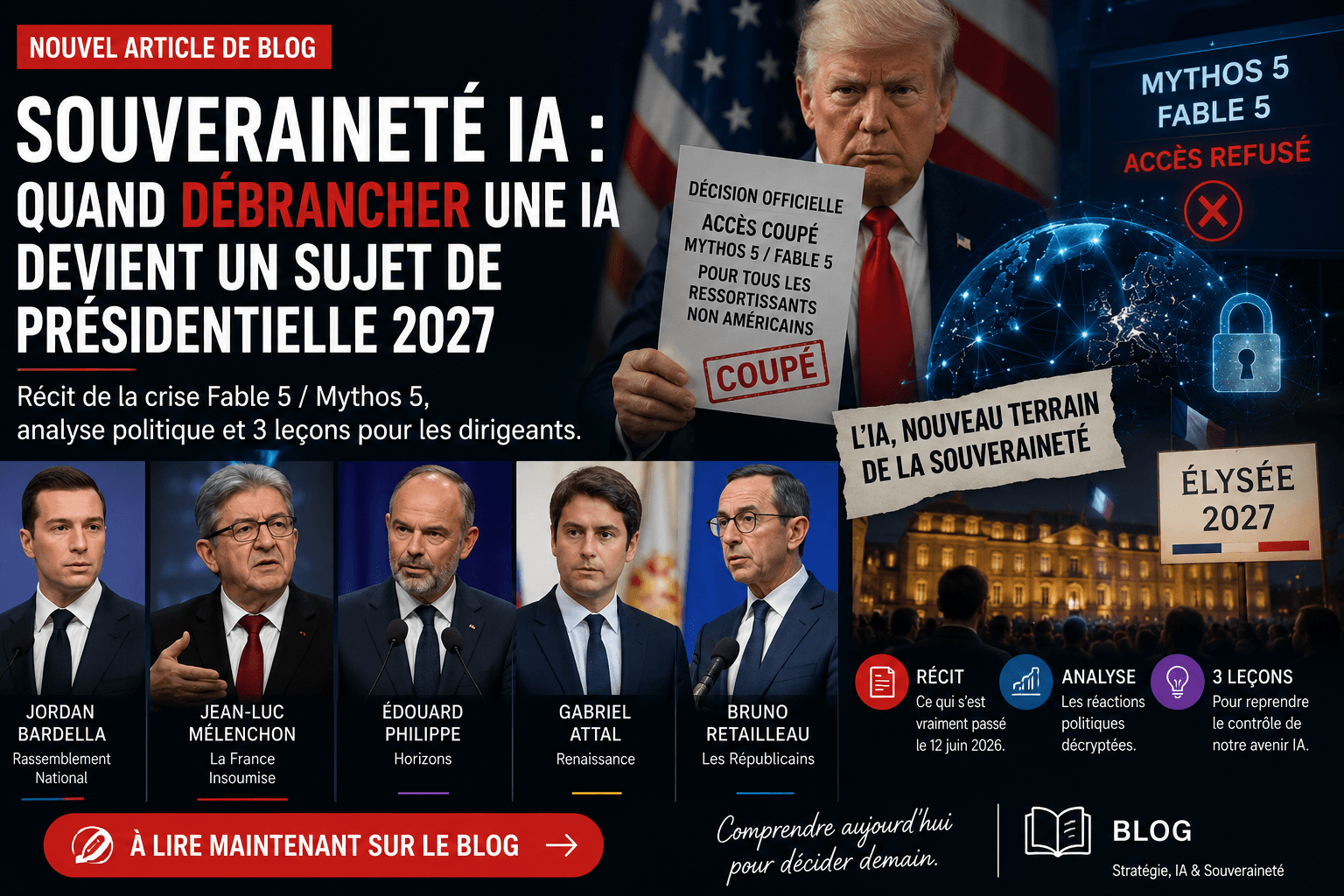
On June 12, 2026, a single letter from the US government was enough to cut all of Europe off from two of the most advanced artificial intelligence models in the world. Within hours, a topic until then reserved for engineers and investors became a presidential campaign theme in France. The story, and an analysis of a turning point.
What happened
On June 12, 2026, the US Department of Commerce sent Anthropic a directive, signed by Commerce Secretary Howard Lutnick, ordering it to suspend access to its two most powerful models (Mythos 5 and its consumer version, Fable 5) for all non-US nationals. The measure targeted foreigners both inside and outside the United States, and even included the company's own foreign employees.
With no technical way to filter users by nationality, Anthropic made the most radical call: an immediate, worldwide shutdown for all its customers. Overnight from Friday to Saturday, both models disappeared. The stated reason falls under export controls and national security: Washington believes it learned of a workaround that made it possible to use Fable 5 to find software vulnerabilities, in other words, for hacking.
This shutdown did not come out of nowhere. As early as March 2026, the Pentagon had terminated its contracts with Anthropic, calling it a "supply chain risk." The company, whose models were the only ones cleared for classified use, went to court, saying it had been punished for refusing to let its AI be used for mass surveillance or autonomous weapons. The June suspension therefore looks like the climax of a standoff between an administration and a company that has made safety and ethics its core selling point.
For millions of European users and businesses, the message is crystal clear: a critical tool, built into the heart of business processes, can be switched off overnight by the political decision of a foreign state.
A political earthquake in France: an unprecedented convergence
This is where the affair changes in nature. Normally, the suspension of an American software product would never have left the business pages. But the timing decided otherwise: France's 2027 presidential campaign is underway, and the topic forced its way in within twenty-four hours.
The striking political fact is not the variety of reactions. It is their convergence. For the first time since ChatGPT arrived, leaders ranging from the far-right Rassemblement national to the far-left La France insoumise, by way of the center-right Republicans, the center and the social democrats, reached the same diagnosis: Europe is overly dependent on American models, infrastructure and computing capacity.
Gabriel Attal (Renaissance, President Macron's party): the geopolitical framing
The former Prime Minister chose the most martial tone. "The AI war has already begun," he said, extending the strategic metaphor: "We cannot rely on others because it makes us vulnerable, as the United States' decision shows. Anthropic is their Strait of Hormuz." He went as far as to warn of a risk of "France's total vassalization."
Positioning: modern, tech-friendly, geopolitical. Implicit message: AI has become a national security issue.
Édouard Philippe (Horizons, center-right): industrial pragmatism
The mayor of Le Havre shifted the focus from software to infrastructure: "We control neither the models nor the compute" behind AI, which is "as essential as electricity or the internet." Urging Europe to "wake up," he called for favoring European technology markets and simplifying regulations that, in his view, give American big tech an advantage.
Positioning: managerial, industrial, pragmatic. Implicit message: the problem is not just software, it is also compute.
Bruno Retailleau (Les Républicains, the traditional right): the nuclear analogy
The LR candidate offered the most memorable image: "do with AI what we did with nuclear power," that is, "think of it as part of our sovereignty." His line on dependence struck a chord: a nation that depends on others for its technology is a nation that can be unplugged overnight. In a pointed communication move, he publicly invited Anthropic CEO Dario Amodei to set up in Paris: "you are welcome here."
Positioning: strategic state, national power, reindustrialization. Implicit message: AI must become the nuclear power of the 21st century.
Jordan Bardella (Rassemblement national, far right): national priority
The RN president reacted on X: "This sudden decision reminds us that artificial intelligence is already a major national sovereignty issue." He called on France to step up its support for Mistral AI and the entire French ecosystem.
Positioning: protection, sovereignty, economic patriotism. Note: for the RN, Bardella is the one speaking; there has been no verifiable public reaction from Marine Le Pen so far.
Jean-Luc Mélenchon (La France insoumise, far left): the long-standing sovereigntist line
The LFI leader placed the event in a long-held position: "Since 2016, LFI has classified digital technology as humanity's new frontier and refused to let France be a digital colony of the USA." For him, the decision "proves how urgent it is to be independent and sovereign," while he also saw it as Washington "settling a political score" with a company that "supports ethical AI."
Positioning: against dependence, against Big Tech, strategic state. Implicit message: AI must be a collective strategic asset.
Olivier Faure (Parti socialiste): a powerful Europe
The Socialist Party's first secretary chose the tone of clear-eyed realism: "We have entered a new world where we can rely first and foremost only on ourselves," calling for "building a real European power."
Positioning: a powerful Europe, social democracy, cooperation and regulation.
Raphaël Glucksmann (Place publique, center-left): going after the giants
At a rally in Aubervilliers on June 13, the center-left candidate made digital sovereignty a campaign priority, with a broader angle than AI alone: a head-on attack on the tech giants, accused of harming young people as much as democratic autonomy.
Positioning: digital sovereignty, regulation, defense of democracy.
Beyond the candidates: the government too
The diagnosis goes beyond those running for the presidency. Anne Le Hénanff, France's Minister Delegate for Digital Affairs, said: "More than ever, European digital sovereignty is a necessity," noting that the major powers now treat strategic technologies as instruments of power.
What this convergence really reveals
A convergence this broad is suspect if you stop at the word "sovereignty." Behind the shared term lie radically different projects:
- For Attal and Philippe, sovereignty is a competitiveness and investment project, to be pursued within the market and within Europe.
- For Retailleau, it is a matter for a strategic state and public procurement, modeled on the nuclear industry.
- For Bardella, it is economic patriotism centered on the nation and on Mistral.
- For Mélenchon and Glucksmann, it is a critique of platform hegemony and a case for public or democratic control of technology.
In other words, everyone agrees on the diagnosis (dependence) but no one agrees on the remedy. That is exactly what turns an apparent consensus into a real campaign divide in the making. The 2027 debate will not be about should France be sovereign in AI? but about what kind of sovereignty, funded how, and in the name of what?
One caveat is also in order about how to read the event. The US directive officially targets a cybersecurity risk, and Anthropic disputes the arguments put forward. Part of the French political class mostly sees it as an opportunity to tell a story they had already written. Intellectual caution means separating what the crisis proves (how fragile a technical dependence is) from what it serves (pre-existing campaign strategies).
Three lessons for businesses and the French AI ecosystem
Beyond politics, the episode sends a very concrete signal to leaders who have built processes on third-party models. Three messages, now shared across party lines, can frame the thinking:
1. Sovereignty: "our data, our models, our infrastructure." Controlling your data and where it is processed is no longer just a lawyer's concern. It is a business continuity parameter.
2. Resilience: "keep working even when a foreign provider cuts off access." The most operational lesson of the crisis is about dependence on a single model. An architecture that lets you switch from one model to another, including to European or open solutions, is no longer an engineering luxury but an insurance policy.
3. Adoption: "sovereignty is not just about owning models, but about knowing how to use them effectively." Owning a sovereign model is useless if your teams don't put it to work. Real independence is decided as much in everyday use as in owning the technology. That is exactly what an AI maturity assessment measures: not the tool you own, but your organization's ability to get value from it, without blind dependence. On that note, the real budget line to manage is no longer the price per token but the human investment that turns technology into value, a shift explored in The AI bill is the wrong question.
In one sentence
In a single weekend, the Fable 5 / Mythos 5 crisis achieved what years of speeches had not: in the eyes of the 2027 candidates, it turned artificial intelligence from an innovation topic into a national sovereignty issue.
Article written on June 14, 2026 from public sources (Euronews, Boursorama/AFP, Yahoo Actualités, Reuters via the French press). Quotes are reported as relayed by these outlets following the statements of June 12 and 13, 2026, and translated from French.
Take action on your AI strategy
The GENIAL AI self-assessment measures your AI maturity and gives you prioritized use cases in under 5 minutes. Free, no commitment.
Related articles
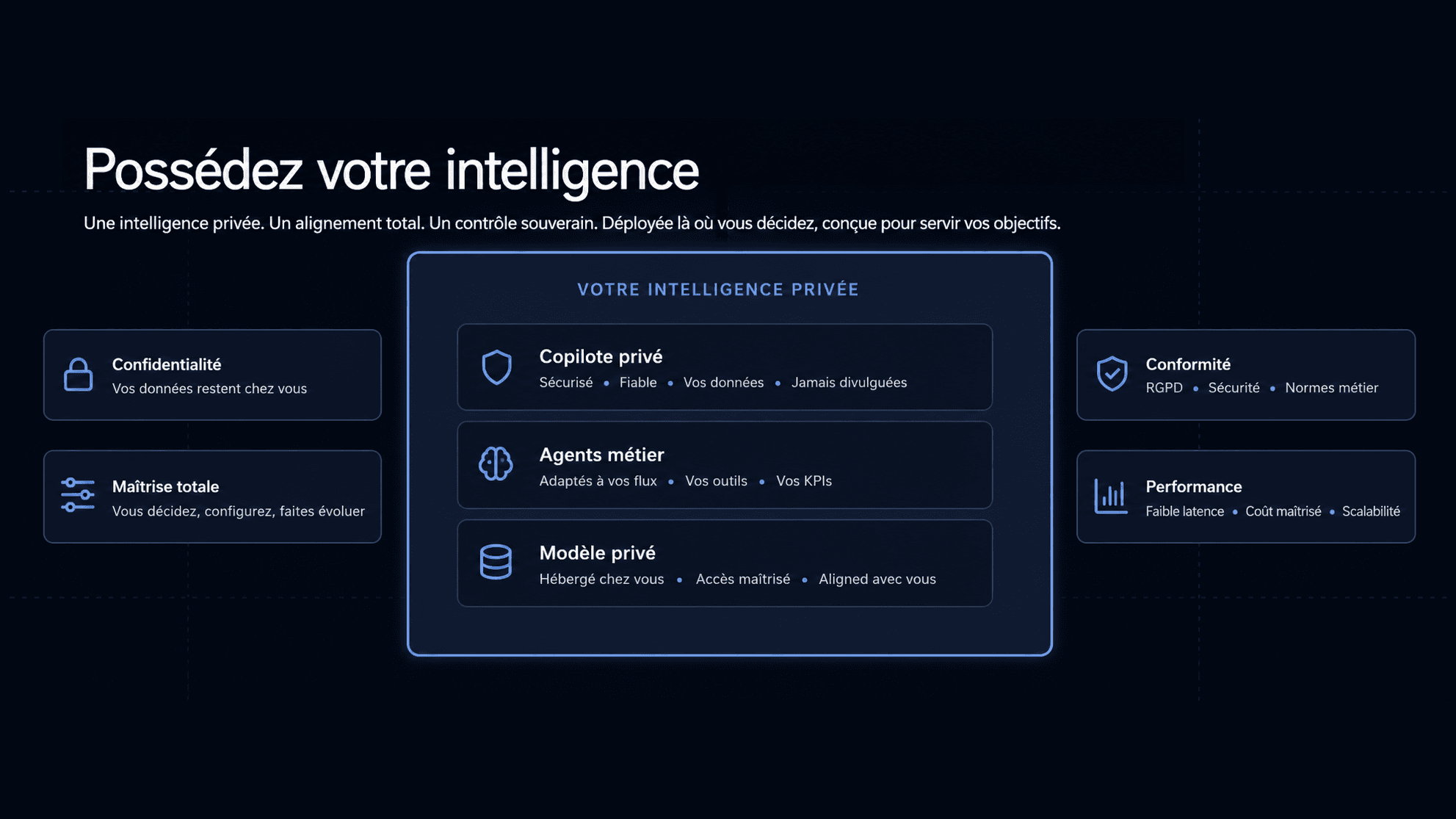
Own Your Intelligence: Sovereign AI in Practice
Renting an AI model is not owning it. What an SMB or mid-market company must control for its AI to become an asset: model, harness, context and memory.
The Claude × LinkedIn Revolution
How next-gen AI agents are reinventing B2B prospecting, content and sales. The complete playbook: framework, 15 ready-to-use prompts, compliance, ROI.
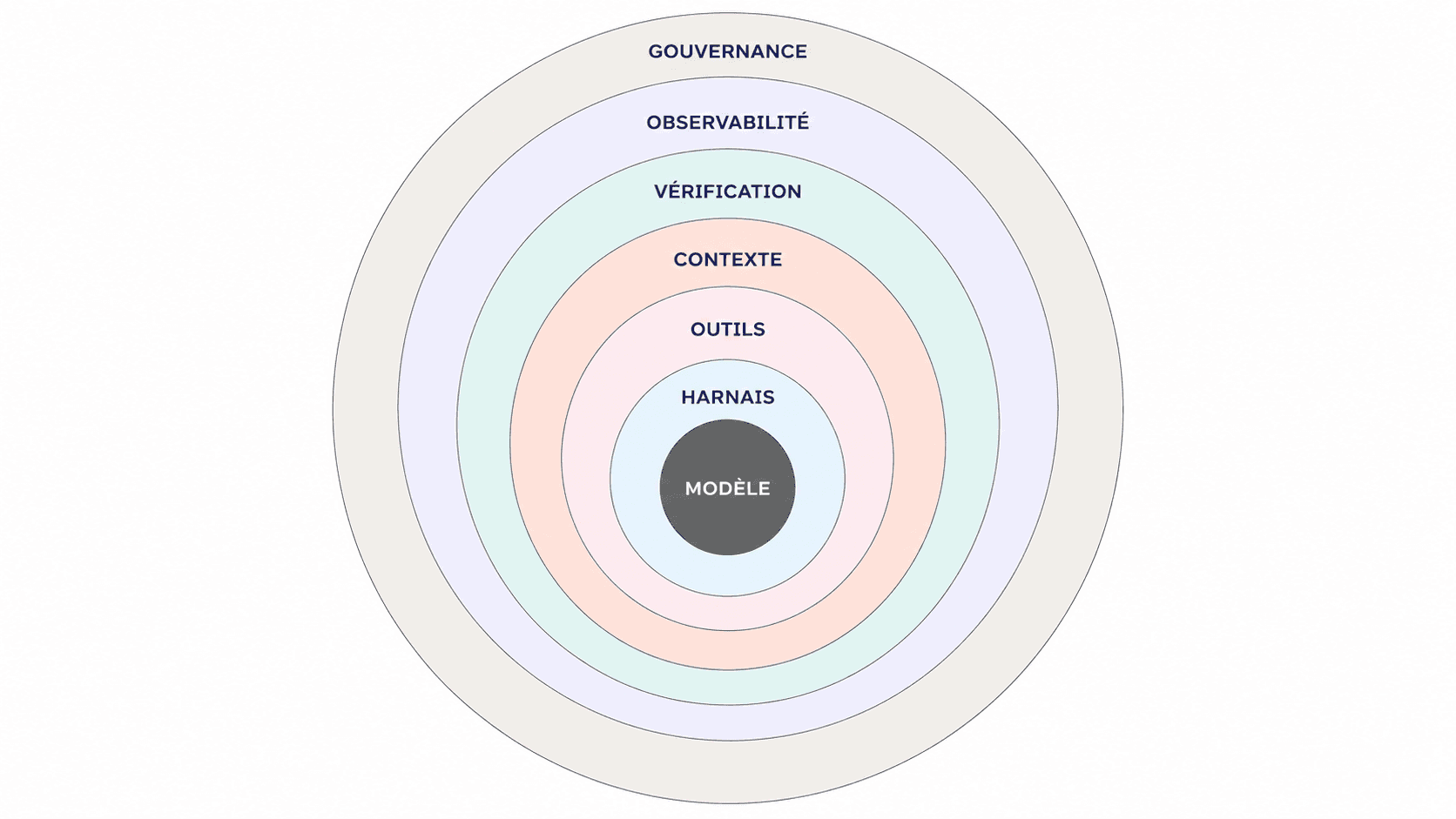
Why 95% of AI Agent Projects Fail
95% of AI agent projects deliver no ROI. The cause isn't the model, it's the engineering layer. The 5 reasons they fail and the questions to ask.