
The Claude × LinkedIn Revolution
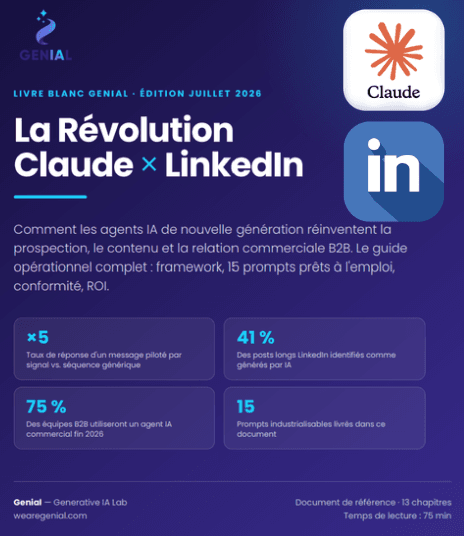
How next-gen AI agents are reinventing B2B prospecting, content and sales. The complete playbook: framework, 15 ready-to-use prompts, compliance, ROI.
What you'll learn
- The 7-stage engine framework, from ICP to Track & Learn
- The 8 Conversation Design principles that replace the dead template
- 15 prompts built to scale, ready to copy and adapt tonight
- The LinkedIn, GDPR and EU AI Act compliance framework, with hard limits
- 9 KPIs, 2026 benchmarks and an ROI calculation model
- The 30-60-90 day rollout plan, week by week
July 2026 edition · 13 chapters · 75-minute read
On July 24, 2026, Anthropic releases Claude Opus 5. Within hours, the tech industry talks about only one thing: code. Fair enough, but meanwhile a far bigger shift is flying under the radar. For the first time, a model can carry an entire sales conversation on its own, from the first message to the booked meeting. Not write a message: carry a conversation, over days, with dozens of prospects in parallel, adapting to every reply.
It's a change in kind, not in degree. And it arrives exactly when LinkedIn is becoming both the most powerful B2B channel in the world and the most saturated in its history.
The hardest thing in prospecting has never been writing a good message. It has always been writing a good one for each person, then replying to every one of them, at the right time, without ever letting go.
That work was humanly impossible to do at scale. So nobody did it: people sent templates. And the templates got ignored, until the whole channel degraded.
The paradox behind the whole document
LinkedIn hasn't lost any of its power. In France, the platform has 34 million members, more than half of the working population, and it generates 80% of B2B leads from social media. Sales reps who actively practice social selling create 45% more opportunities and are 51% more likely to hit quota. Above all, a business buyer has already covered 57% of their buying journey before talking to a salesperson, so the battle is fought upstream, in the space where the prospect researches and watches.
But the channel is drowning in its own noise. An analysis of more than a million posts by Pangram found that 41% of long-form posts on LinkedIn are identified as AI-generated.
Hence the paradox: AI is both the cause of the saturation and the only way out of it. Not by producing more, but by producing precisely: what a good salesperson did by hand, now at scale.
What you'll find in the white paper
No "autopilot" promise, no recipe for industrial-scale spam. A system: an architecture, fifteen prompts you can copy tonight, a compliance framework that keeps you from losing your account, and an honest measurement method.
| # | Chapter | Content |
|---|---|---|
| 01 | LinkedIn 2026: the real state of play | Saturation, collapsing rates, tighter rules |
| 02 | What Claude Opus 5 really changes | The 5 capabilities that matter, and the ones that don't |
| 03 | From template to Conversation Design | The paradigm shift and its 8 principles |
| 04 | The 7-stage engine | The complete operational framework, stage by stage |
| 05 | The library of 15 prompts | The heart of the document: copy, paste, adapt |
| 06 | Scaling up: the 4 maturity levels | From copy-paste to the connected agent |
| 07 | The other half of the game: content | The 2026 algorithm, the Signal → Post → Conversation system |
| 08 | Compliance: LinkedIn, GDPR, EU AI Act | Hard limits and the charter to follow |
| 09 | Measuring: the dashboard and ROI | 9 KPIs, 2026 benchmarks, calculation model |
| 10 | The 30-60-90 day plan | Rollout week by week |
| 11 | The 7 mistakes that kill the system | What we see failing in the field |
| 12 | FAQ: 16 straight questions | The objections we actually hear |
| 13 | Appendices | Scored self-assessment, glossary, sources |
The 7-stage engine
The operational core of the document is a seven-stage framework, each stage with its own role and prompts:
- ICP and signals: define with surgical precision who you're targeting, and how to tell a target is ready.
- Signal-based sourcing: this is where most of the reply rate is won or lost. The same message sent to a cold list and to a signal-qualified list are worlds apart.
- Prospect research: read the profile, recent posts and career path, and pull out something to hook onto.
- The icebreaker: the most important message in the system. It sells nothing, pitches nothing, asks for nothing.
- Conversation management: the brain of the setup, a single prompt loaded with your full context.
- Closing: a judge, not a salesperson. It reads the conversation and returns a yes-or-no verdict.
- Track & Learn: every week, you feed the model past conversations, the ones that converted and the ones that failed.
The 8 principles of Conversation Design
The template is dead for three reasons: readers recognize the format, the platform punishes volume, and a template can't handle the follow-up. In its place, eight writing principles; the first five set the tone:
- Thirty words max
- Never open a sentence with a verb
- Zero filler words
- The em dash is an AI signature
- Never ask for a meeting in the first message
The last three principles, the fifteen full prompts, the compliance framework and the ROI model are in the document.
Who this document is for
Leaders of SMBs and mid-market companies, founders, sales directors, B2B marketing managers, freelancers and consultants. No technical skills required: everything described is done in a chat interface, in a browser. Chapters 6 and 10 are also aimed at teams that want to scale up.
Read and download the full white paper (in French), free
Leave your email: the document opens right here on the page, and we'll also email it to you for later. The full white paper is available in French only.
By submitting, you agree to be contacted by GENIAL. Unsubscribe in one click.
Take action on your AI strategy
The GENIAL AI self-assessment measures your AI maturity and gives you prioritized use cases in under 5 minutes. Free, no commitment.
Related articles

AI: Your Vendors Will Sell the Work, Not the Tool
The shift from copilot to autopilot redefines what you'll buy in AI: not software, but a delivered result. What it changes for your SMB.
AI in Travel and Tourism: Real Use Cases and Gains
How AI is transforming tourism: multilingual customer service, content, booking, back office. Real use cases and gains, backed by field data.
The 10 AI Use Cases With the Best ROI for SMBs
Our top 10 most profitable AI use cases for an SMB: automation, customer service, finance, operations. With the gains you can expect.