
AI in Travel and Tourism: Real Use Cases and Gains
How AI is transforming tourism: multilingual customer service, content, booking, back office. Real use cases and gains, backed by field data.
Tourism is a business of customer relations at scale: high request volumes, international customers, a constant need for content, strong seasonality and a fragmented ecosystem of hotels, restaurants, agencies, tourism offices, leisure sites and transport operators. All of these traits make it especially fertile ground for artificial intelligence. Here, without jargon and with real use cases, is what AI actually changes.
Why tourism is ideal ground for AI
Three traits of the industry explain AI's fast impact:
- A huge, multilingual volume of communication. Booking requests, practical questions, complaints, reviews: teams spend a lot of time replying, often in several languages.
- A constant need for content. Property listings, offer descriptions, web pages, social media, newsletters: tourism sells through content, which has to be produced, translated and kept up to date.
- Repetitive back-office tasks. Product data entry, package building, database updates, processing incoming emails: invisible but time-consuming work, a perfect candidate for automation.
AI doesn't replace hospitality; it frees up time to focus on it.
The AI use cases that create the most value
The examples below come from assessments carried out at real tourism businesses (anonymized). They fall into four families.
Customer service & booking
- Conversational B2B/B2C chatbots and FAQs, available 24/7 and multilingual, that qualify requests and steer guests toward direct booking.
- A conversational answer engine on your website (tourism office, observatory) that answers in plain language from your own content.
- AI-assisted replies to emails and reviews, for responsive customer relations without overloading teams.
Content & marketing
- Automatic generation of product listings and offer descriptions.
- AI content studio: posts, newsletters and visuals adapted by audience and by language.
- Updating property listings at scale (several thousand hotels or providers) without manual data entry.
Operations & back office
- Automatic sorting and classification of incoming emails (for example, hotel stop sale notifications).
- AI-assisted package building: a pre-filled form instead of Excel, with automated quality checks on the package.
- Automated product data entry in the back office and cleaner databases (SIT, France's regional tourism information systems, and catalogs).
Management & administration
- Automatic minutes and summaries of meetings and site visits.
- OCR and accounting automation for invoices and receipts.
- An augmented tourism observatory: analysis of demand, occupancy and quality, with results reported in plain language.
For a cross-industry view, see also the 10 AI use cases with the best ROI for SMBs.
What our field data shows
Across about ten tourism businesses assessed, more than 110 AI use cases were identified and scored. Two findings:
- The most immediate gains are in marketing/content and operations: listing creation, automated data entry, email sorting and package building consistently rank among the highest scored.
- Multilingual customer service is the differentiating lever: it's what turns time saved into additional bookings and traveler satisfaction.
These priorities match what we see more broadly: AI creates value first at the core of the business, not on the periphery.
The conditions for success
The challenge isn't the technology, it's the scoping. Four points make the difference:
- Start from the real time-consuming tasks, role by role, rather than from a trendy tool.
- Secure data and compliance (GDPR, EU AI Act, customer and booking data) from the start. Also watch out for informal uses already in place: see Shadow AI.
- Choose tools that fit and integrate with what you already have (PMS, channel manager, CRM, SIT). To find your way, see our selection of AI tools for SMBs.
- Bring your teams on board: adoption is won by solving their daily pain points, not by imposing one more tool.
Where to start
The best way in is still to measure your starting point and prioritize. An assessment gauges your maturity, maps your use cases and gives you a roadmap; that's the subject of our articles on what an AI assessment lets you do, have and achieve and on how to run one. In a few minutes, the AI self-assessment for tourism gives you a first score and prioritized use cases for your business.
Take action on your AI strategy
The GENIAL AI self-assessment measures your AI maturity and gives you prioritized use cases in under 5 minutes. Free, no commitment.
Related articles
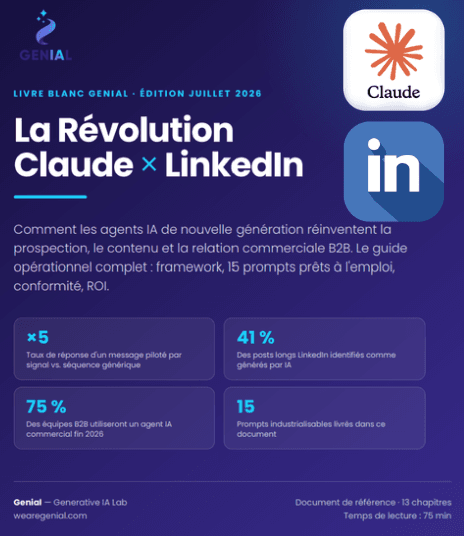
The Claude × LinkedIn Revolution
How next-gen AI agents are reinventing B2B prospecting, content and sales. The complete playbook: framework, 15 ready-to-use prompts, compliance, ROI.

AI: Your Vendors Will Sell the Work, Not the Tool
The shift from copilot to autopilot redefines what you'll buy in AI: not software, but a delivered result. What it changes for your SMB.
The 10 AI Use Cases With the Best ROI for SMBs
Our top 10 most profitable AI use cases for an SMB: automation, customer service, finance, operations. With the gains you can expect.