
AI: Your Vendors Will Sell the Work, Not the Tool
The shift from copilot to autopilot redefines what you'll buy in AI: not software, but a delivered result. What it changes for your SMB.

A small business might pay €10,000 a year for its accounting software and €120,000 for the accountant who closes the books. The next generation of AI companies won't sell you better accounting software. It will close your books. That line, from Julien Bek (Sequoia Capital) in March 2026, sums up a shift that will hit every kind of knowledge work, including the services your company buys every month.
For the leader of an SMB or a mid-market company, the question is no longer "which AI tool should we adopt?" It becomes "what will I keep buying as a tool, and what will I buy as work already done?"
Selling the tool or selling the work: why the difference changes everything
Selling finished work rather than the tool is becoming the winning AI strategy in business. The reason is simple. A software vendor that sells a tool is in a constant race against the models: with every new version of Claude or GPT, its product risks shrinking to a feature built in somewhere else. A company that sells the result, by contrast, benefits from every model improvement. The better AI gets, the faster, cheaper and harder to compete with its service becomes.
For you as a buyer, the consequence is concrete. The "work" budget far exceeds the "software" budget in any line of business. According to Sequoia's analysis, for every dollar spent on software, six are spent on services. It's that services budget, until now reserved for firms and human providers, that the new AI players are going after directly.
Two models coexist today, and the distinction is worth understanding before making any decision.
| Model | What you buy | Who is responsible for the result | Example |
|---|---|---|---|
| AI copilot | A tool that makes your team more productive | Your employee, who drives the tool | A legal drafting assistant used by your lawyer |
| AI autopilot | The finished result, delivered directly | The AI provider | A platform that drafts and delivers your contract |
Intelligence or judgment: the line that decides everything
The line between what AI does on its own and what requires a human runs between intelligence and judgment. Intelligence means turning a specification into a deliverable: applying rules that are complex but stable. Judgment means knowing what to do next: choosing the next priority, accepting technical debt, deciding to ship before it's perfect. That takes experience and taste, built over years of practice.
Software development crossed that threshold first. It accounts for more than half of AI tool usage across all professions, while every other category stays in single digits. The reason: coding is mostly intelligence. AI now does most of the intelligence work on its own and leaves the judgment to humans.
What happened to code is coming to every profession. The practical rule to remember: the higher a task's intelligence ratio, the sooner it will be automated end to end. That's exactly what an AI maturity assessment maps out in your company.
Which services will flip first?
The services that flip first are the ones you already outsource and that rely mostly on intelligence. If a task is already handed to an outside provider, it meets three favorable conditions: the company has accepted that it's done outside, there's an identified budget, and the buyer already buys a result, not a tool. Replacing an outsourcing contract with an AI player is simply a change of supplier. Replacing an employee would be a reorganization.
Here are the sectors Sequoia's analysis identifies as the most ready, with their addressable global labor market:
- Insurance brokerage ($140-200B): on standard lines, the broker's added value comes down to comparing insurers and filling out forms. Pure intelligence.
- Accounting and audit ($50-80B outsourced in the United States alone): a structural shortage of accountants and a wave of retirements. Firms are adopting AI faster than almost any other profession.
- Medical billing ($50-80B): translating clinical notes into standardized codes. Complex rules, but rules.
- Transactional legal work ($20-25B): drafting contracts, NDAs, regulatory filings. Standardized work, already outsourced, with verifiable quality.
- Managed IT services ($100B+): monitoring, patching, access management. The same process repeated across thousands of identical environments.
At the other end of the spectrum, strategy consulting ($300-400B) remains mostly judgment. The real question for that profession is whether AI will be able to separate the intelligence part (data collection, benchmarking) from the judgment part (strategic recommendation) and automate only the first.
What this shift changes for your SMB or mid-market company
In practice, you'll gradually replace some "services" budget lines with results delivered by AI, starting with your most standardized outsourced tasks. A sensible approach takes three steps.
- Take stock of your outsourced services. Accounting, payroll, regulatory monitoring, standard contract drafting, IT support. List what you already pay outsiders for as a result.
- Assess the intelligence-to-judgment ratio of each one. A highly rule-based task, with no calls of taste, is a candidate for an autopilot. An engagement that relies on experience and relationships stays human, for now.
- Test by substitution, not reorganization. Start where you only need to change suppliers. The risk is contained, the budget already exists, the return on investment is immediate.
One note on timing. Today's judgment will become tomorrow's intelligence. As AI systems accumulate data on what good judgment looks like in their field, the line moves. The services you think are "too human" today will flip in turn. That's why it pays to map your tasks now rather than react in a rush.
In short: the question is no longer "which AI tool should I buy?" but "which of my services will I soon buy as work already done?" Start with your most standardized outsourced tasks: that's where the shift will be fastest and least risky.
This lens (intelligence versus judgment, outsourced versus in-house) is exactly what a structured assessment applies to your business. To find out which tasks in your company are ready for an AI autopilot and which still call for a copilot, assess your AI maturity with the GENIAL self-assessment. In five minutes, you get a first map of your opportunities, ranked by feasibility and return on investment.
Read next to take this further: why the AI bill is the wrong question and what a business leader must do, avoid and get right in an AI assessment.
Erwan Simon is CEO and co-founder of GENIAL (Generative IA Lab), a Bordeaux-based company that helps French SMBs and mid-market companies put generative AI to work. An accredited AI Expert with Bpifrance (France's public investment bank) and an ambassador of "Osez l'IA," the French government's program to help businesses adopt AI, he has been rolling out AI assessments and use cases in companies for several years.
Take action on your AI strategy
The GENIAL AI self-assessment measures your AI maturity and gives you prioritized use cases in under 5 minutes. Free, no commitment.
Related articles
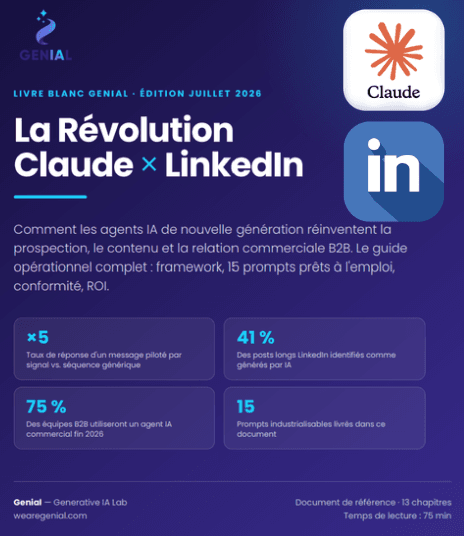
The Claude × LinkedIn Revolution
How next-gen AI agents are reinventing B2B prospecting, content and sales. The complete playbook: framework, 15 ready-to-use prompts, compliance, ROI.
AI in Travel and Tourism: Real Use Cases and Gains
How AI is transforming tourism: multilingual customer service, content, booking, back office. Real use cases and gains, backed by field data.
The 10 AI Use Cases With the Best ROI for SMBs
Our top 10 most profitable AI use cases for an SMB: automation, customer service, finance, operations. With the gains you can expect.