A fast-growing software company doesn't hire support staff as fast as it signs customers. Every new nonprofit arrives with the same questions as the previous ones, and those questions come in four languages, on two continents, from organizations whose practices differ from one country to the next.
The cost of that growth isn't measured in tickets. It's measured in what the support team no longer does: helping complex customers, writing documentation, flagging pain points to the product team. That time goes into repetition.
That was the starting point of the project with Yapla: not replacing support, but giving it back the hours repetition was taking.
The starting point: growth that support couldn't keep up with
The influx of new members pushed recurring questions and support tickets up faster than the team could grow. The overload didn't stop the team from answering: it stopped the team from doing anything but answering.
On top of that came the linguistic and cultural diversity of the customer base, which makes onboarding new users harder and personalized exchanges costly. The same question asked in Montreal and in Milan doesn't call for quite the same answer.
- Reduce repetitive requests to free up internal teams.
- Offer new users a smooth, personalized onboarding.
- Account for linguistic and cultural differences in every exchange.
- Streamline ticket handling to raise customer satisfaction.
Two months writing down what the teams already knew
The quality of an agent's answers doesn't come from the model: it comes from what you give it to read. So the project began with two months of building the knowledge base, from the Zendesk history, the FAQ question-and-answer file and the knowledge base articles.
Most of that work meant writing down the support teams' know-how: what they answered, in what order, with what precautions depending on the nonprofit's profile. Part of that knowledge existed nowhere but in the habits of the people who answered.
Yapla IA, inside the software, not next to it
The agent is available right inside the platform, where users run into their problem. It answers frequent questions (memberships, online ticketing, fundraising, website building) and walks users through the interface step by step instead of sending them to an article.
It serves two audiences from the same base: end customers, who get an instant answer, and the support teams themselves, who use it to work through the requests they handle.
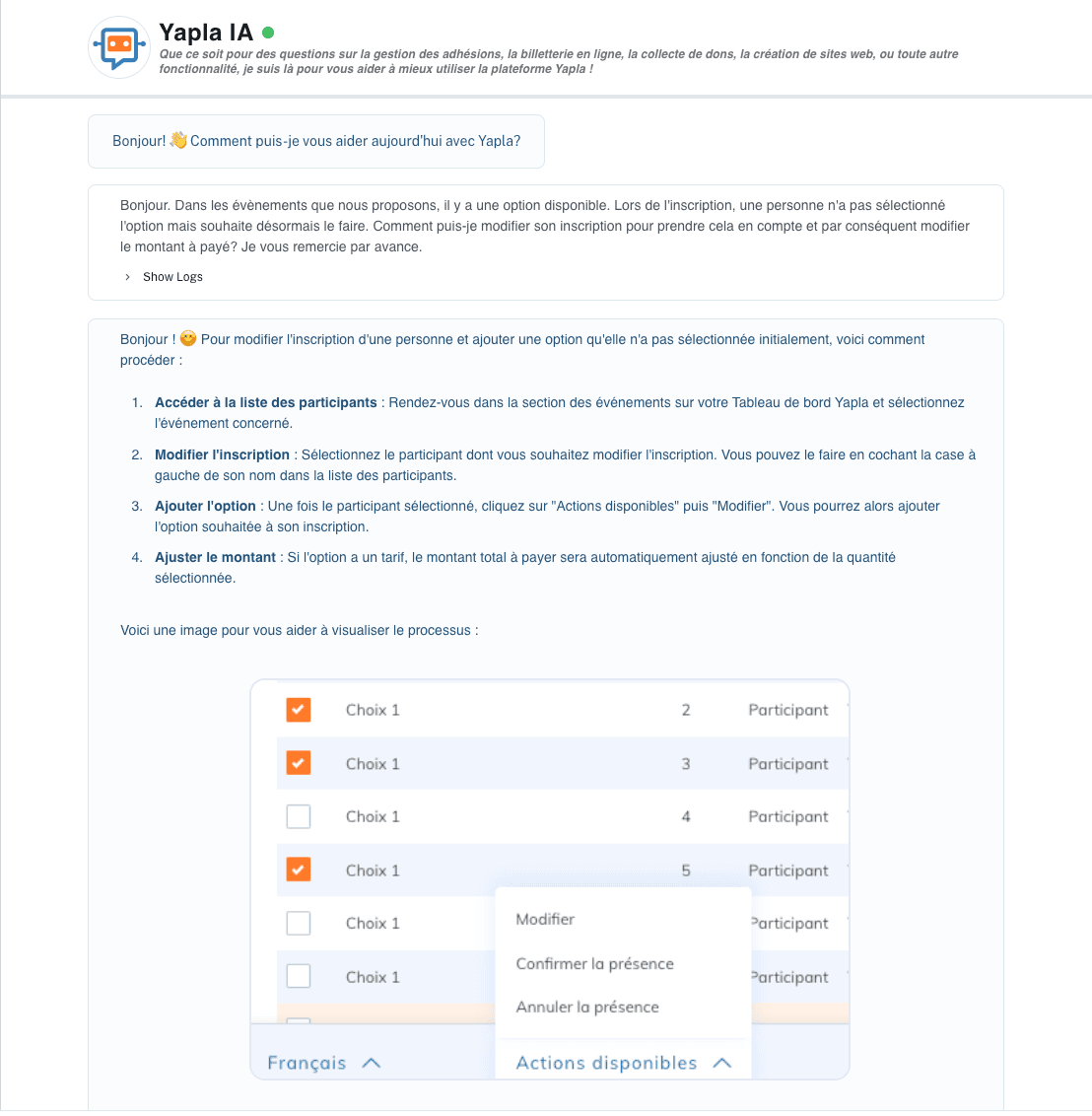
Four languages, including two kinds of French
The agent answers in French, English, Canadian French and Italian. Telling French from France apart from Canadian French isn't a nicety: nonprofit vocabulary, reporting obligations and payment practices differ from one country to the next, and an answer that is right in Paris can be wrong in Montreal.
What goes to a human
The three tickets out of ten the agent doesn't handle aren't failures: they're the requests that need a person. The agent automatically escalates them to a human, with the context of the conversation already assembled.
That's what makes the 70% figure meaningful. Support didn't disappear; it moved to the cases that deserve it.